

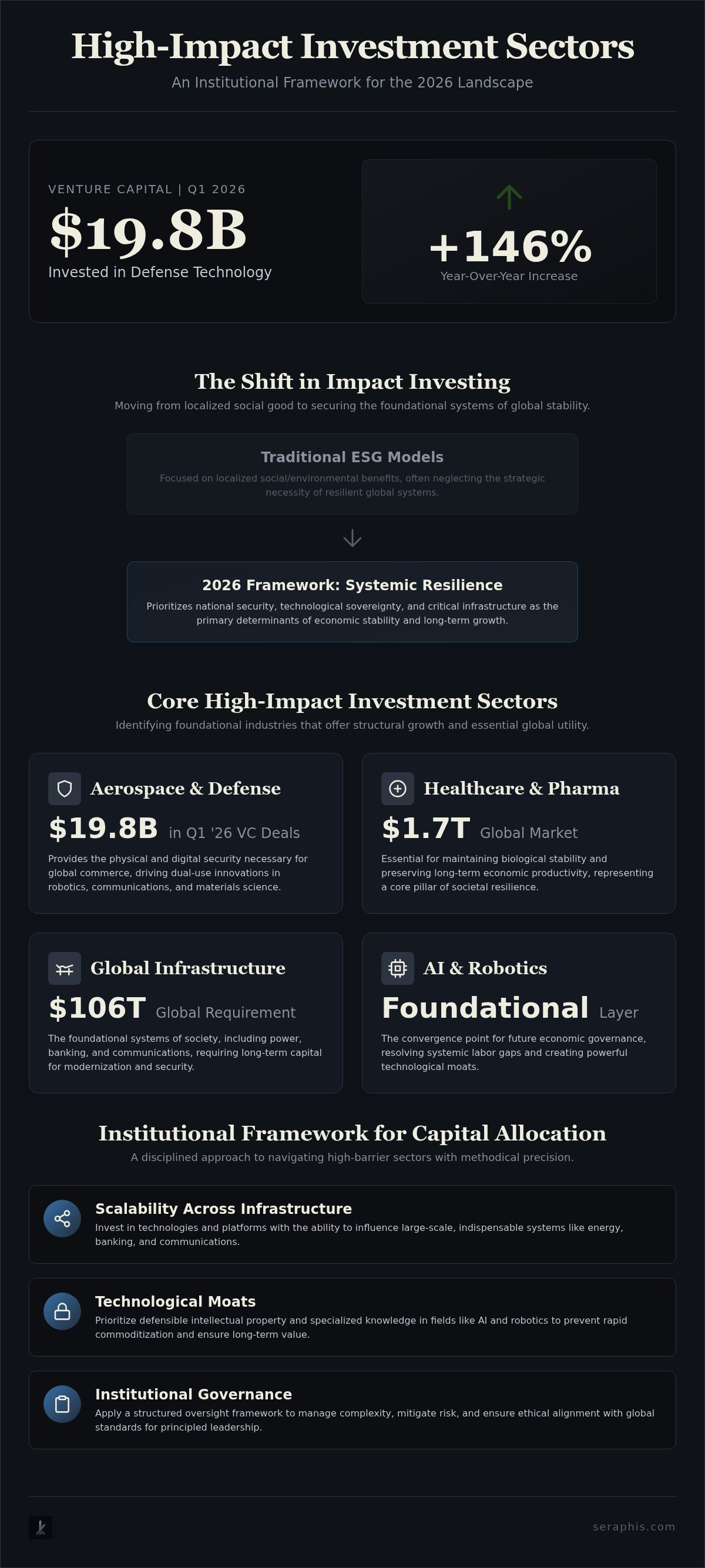
Venture capital investment in defense technology reached 19.8 billion dollars in the first quarter of 2026, representing a 146 percent increase over the previous year. This surge reflects a fundamental shift in how institutional capital views national security and global stability. Many investors recognize that the traditional definition of impact has become overly narrow, often neglecting the critical systems that underpin modern society. Identifying high impact investment sectors now requires a sophisticated understanding of how defense innovation, healthcare resilience, and strategic infrastructure interact to maintain global order. You've likely observed the difficulty of navigating these high-barrier industries without a robust governance framework.
This analysis provides an institutional-grade framework to align capital with the long-term trends defining 2026. We'll examine the integration of artificial intelligence within aerospace and the 1.7 trillion dollar pharmaceutical market, while establishing the role of strategic governance in emerging technology. By moving from foundational principles to operational applications, this briefing clarifies how to navigate sectors that offer both structural growth and essential global utility. We explore the 106 trillion dollar global infrastructure requirement and the rapid evolution of robotics, ensuring that your strategy remains anchored in methodical precision and principled leadership.
Key Takeaways
- Transition from traditional ESG models to a systemic resilience framework to accurately identify high impact investment sectors within the 2026 landscape.
- Evaluate how defense and aerospace innovations serve as primary drivers for dual-use technological advancements and the modernization of critical global infrastructure.
- Examine the strategic importance of pharmaceutical and healthcare investments in maintaining biological stability and preserving long-term economic productivity.
- Identify the convergence of artificial intelligence and robotics as the foundational layer for future economic governance and the resolution of systemic labor gaps.
- Establish an institutional-grade framework for strategic governance to manage the inherent complexities of multi-sector global capital deployment.
Defining High Impact Investment Sectors in the 2026 Landscape
The global economic environment in 2026 demands a recalibration of how capital generates meaningful outcomes. Historically, the investment community viewed "impact" through the lens of localized social or environmental benefits. Current geopolitical and technological shifts have rendered these definitions insufficient. Identifying impact investing today requires a focus on systemic resilience, where the stability of global markets depends on the strength of critical foundations like defense, healthcare, and infrastructure. This convergence of private capital and institutional governance ensures that resources aren't just seeking returns, but are actively securing the frameworks that allow society to function.
The Shift from Social Good to Systemic Importance
Traditional ESG metrics often struggle to address the complexities of a fragmented global economy. In 2026, the concept of impact has expanded to include national security and technological sovereignty, as these factors are now the primary determinants of economic stability. Basic environmental or social scores fail to account for the strategic necessity of resilient supply chains and autonomous systems. High-impact investing in 2026 is the alignment of capital with global structural needs. For a private investment office, the goal is to identify high impact investment sectors that provide defensive value while driving the innovation required for long-term growth. This approach moves beyond philanthropic intent toward a mandate for systemic preservation.
Criteria for High Impact Allocation
Strategic capital allocation requires a rigorous framework that prioritizes sectors with significant barriers to entry. These barriers, whether regulatory, technological, or capital-intensive, serve as a proxy for long-term value and protection against market volatility. High impact sectors often involve assets that are indispensable to national or global operations, such as aerospace technology or pharmaceutical manufacturing.
Effective allocation focuses on three primary pillars:
- Scalability across infrastructure: The ability to influence large-scale systems like power generation, banking, and communications.
- Technological Moats: Intellectual property and specialized knowledge that prevent rapid commoditization in fields like AI and robotics.
- Institutional Governance: The application of structured oversight to manage complexity and ensure ethical alignment with global standards.
Private markets are uniquely positioned to address these needs because they allow for the long-term capital horizons required to build and sustain critical infrastructure. Short-term market pressures often discourage the patient investment needed for systemic change. By focusing on these criteria, investors ensure their capital is positioned within high impact investment sectors that define the future of global stability. This methodical precision distinguishes institutional-grade strategy from speculative participation.
Aerospace and Defense: The Strategic Security Impact
Aerospace and defense represent a fundamental cornerstone among high impact investment sectors because they provide the physical and digital security necessary for global commerce to function. In the first quarter of 2026, venture capital deals in defense technology reached a record 19.8 billion dollars, marking a 146 percent year-over-year increase. This surge in capital deployment isn't merely about military hardware. It reflects a growing recognition that defense innovation serves as a primary driver for dual-use technological advancement. Technologies developed for sovereign security often find critical applications in civilian infrastructure, from satellite communications to advanced materials science.
Innovation in Defense Technology
The integration of robotics and autonomous systems has become a central pillar of modern security frameworks. These systems offer enhanced precision and reduced risk, but their development requires significant capital and long-term horizons. Private investment is increasingly essential for sovereign technological development, allowing nations to maintain a competitive edge without relying solely on public budgets. Frameworks such as Stanford's High Impact Technology Fund highlight the necessity of aligning research with clear market needs and competitive advantages. Investors who focus on next-generation aerospace platforms contribute to a global connectivity network that is both resilient and secure.
Infrastructure and Global Stability
Global stability relies on the integrity of supply chains, which are increasingly vulnerable to geopolitical shifts. Strategic aerospace investments help secure these networks by modernizing logistics and surveillance capabilities. There's a direct relationship between disciplined defense spending and broader economic resilience. When private capital modernizes defense infrastructure, it creates a stabilizing effect that benefits banking, trade, and energy sectors. Managing these cross-border projects requires institutional rigor to navigate complex regulatory environments. Investors seeking to align their portfolios with these structural trends can benefit from sophisticated defense investments that prioritize both security and governance.
Ethical considerations remain paramount in this sector. While some traditional frameworks have historically avoided defense, the current landscape of 2026 demonstrates that security is a prerequisite for any meaningful social or environmental progress. A principled investment office ensures that capital deployment follows strict governance protocols, focusing on technologies that preserve order and protect human capital. This methodical approach transforms defense from a controversial category into a strategic necessity within high impact investment sectors. It's a shift that prioritizes long-term global stability over short-term speculative gains.
Healthcare and Pharmaceuticals: Biological and Economic Resilience
Biological resilience is a prerequisite for global economic continuity. In 2026, the global pharmaceutical industry is projected to reach approximately 1,722.05 billion dollars, representing a growth rate of 5.8 percent from the previous year. This expansion underscores the sector's position as one of the premier high impact investment sectors, providing the necessary defense against systemic biological threats. Beyond immediate medical outcomes, these investments preserve human capital and ensure that the workforce remains productive in an increasingly complex global environment. Strategic asset management in this field requires a focus on specialized infrastructure, from high-containment laboratories to cold-chain logistics, which serve as the backbone of global health security.
Pharmaceutical Innovation and Capital
Private investment offices are increasingly vital in funding the long-cycle research and development required for next-generation specialty and gene therapies. Unlike short-term speculative ventures, institutional-grade pharmaceutical capital management prioritizes the structural importance of drug discovery. The pharmaceutical sector's impact is a combination of medical breakthrough and economic stability. Managing the risk-return profile of these assets in 2026 involves navigating rigorous regulatory landscapes while securing intellectual property that offers long-term defensive value. This patient capital approach allows for the development of treatments that address chronic conditions and emerging pathogens, effectively de-risking the broader economy from the costs of widespread illness.
Healthcare Technology and Digital Integration
The convergence of artificial intelligence and healthcare delivery has transformed how services are allocated and consumed. Telehealth adoption has grown to 75 percent of hospitals in 2026, creating a significant demand for digital health resilience and robust data security. Investors must recognize that digital infrastructure is now as critical as physical clinics. Institutional logic in healthcare sector capital allocation suggests a shift toward outpatient and home-based care models, which are projected to grow by 18 percent and 32 percent respectively by 2035. This transition requires a methodical approach to infrastructure investment, focusing on:
- Data Sovereignty: Ensuring that patient metrics and genomic data are protected by institutional-grade cybersecurity.
- AI-Driven Diagnostics: Utilizing machine learning to increase hospital productivity and reduce the cost of care delivery.
- Remote Monitoring Systems: Scaling technology that allows for continuous patient oversight outside traditional clinical settings.
By integrating these technologies, high impact investment sectors within healthcare offer a dual benefit of improved patient care and systemic cost reduction. This alignment of innovation with institutional governance ensures that healthcare remains a stable, growth-oriented pillar of a global investment strategy. It's about building a healthcare system that is not only technologically advanced but also structurally resilient against future shocks.
Structural Impact: Artificial Intelligence, Robotics, and Infrastructure
Infrastructure is the bedrock of global stability. In 2026, the definition of infrastructure has expanded beyond physical transport to include the digital and automated systems that power the global economy. An estimated 106 trillion dollars in investment is required to meet global infrastructure needs by 2040, a figure that far exceeds the capacity of public budgets. This gap creates a definitive mandate for private capital to enter high impact investment sectors like power generation, data centers, and advanced banking systems. These assets provide the structural resilience required to support the rapid adoption of emerging technologies while offering defensive value in a volatile market.
Artificial Intelligence and Strategic Governance
The global AI market is projected to reach between 539.5 billion and 900 billion dollars in 2026. This growth isn't a mere technological trend; it's a structural shift in economic governance. End-user spending on AI models and platforms is forecasted to reach 64 billion dollars this year, representing a 63.4 percent increase from 2025. Such rapid expansion requires a sophisticated governance framework to manage ethical implications and systemic risks. In the banking sector, machine learning has become foundational for maintaining liquidity and security. Institutional investors use their influence to ensure that AI development aligns with transparency and reliability standards, effectively transforming raw computing power into a stable economic asset.
Robotics and Autonomous Systems
Labor shortages and productivity gaps have accelerated the demand for autonomous solutions across manufacturing and logistics. The global robotics market is estimated to be valued between 38 billion and 88.27 billion dollars in 2026, with the industrial segment alone projected at 65.1 billion dollars. Robotics industry investment serves as a direct solution for maintaining supply chain continuity and infrastructure integrity. Vision-Language-Action models are seeing accelerated adoption, allowing machines to perform complex maintenance tasks that were previously impossible. Private capital plays a critical role in scaling these innovations from specialized laboratories to global deployment.
Investors can secure a position in these structural shifts by leveraging a global investment strategy designed for institutional-grade precision. By focusing on the data layer and the physical hardware of robotics, capital stays aligned with the primary drivers of 21st-century productivity. These technologies have become the new critical infrastructure, making them essential components of any portfolio targeting high impact investment sectors. Success in this landscape depends on the ability to distinguish between speculative software and the foundational systems that secure global growth. This methodical approach ensures that capital deployment remains both principled and effective.
Strategic Governance: The Framework for High Impact Success
The deployment of capital into high impact investment sectors requires more than just financial resources; it demands a comprehensive framework for strategic governance. As global dynamics become increasingly fragmented, the role of the private investment office has evolved from mere asset management to the sophisticated coordination of multi-sector complexity. Success in 2026 relies on the ability to integrate institutional rigor with a clear, long-term vision. This approach ensures that capital remains aligned with both economic objectives and the ethical standards necessary for global stability. Without such a framework, entry into high-barrier industries like defense or critical infrastructure risks being reactive rather than strategic.
The Seraphis Group Approach to Sector Advisory
Effective participation in complex markets depends on leveraging deep industry knowledge, particularly in fields where technology and national security intersect. A private investment office provides the specialized oversight needed to navigate these high-barrier environments. By maintaining a focus on transparent governance, investors ensure that their contributions support systemic resilience while meeting rigorous compliance standards. Accessing Institutional Grade Investment Insights allows for a more nuanced understanding of how defense innovations and healthcare breakthroughs contribute to a stable global order. This advisory-led model prioritizes clarity and methodical precision over speculative haste.
Closing the Gap Between Vision and Execution
The transition from identifying an opportunity to executing a successful deployment requires a disciplined approach to capital allocation. A global strategist looks beyond immediate market volatility to identify the underlying structural trends that define 2026. This perspective allows for the patient management of assets that may take years to reach full maturity, such as large-scale infrastructure or pharmaceutical R&D. By maintaining a steady and organized rhythm, an institutional leader ensures that every decision is deliberate and carefully considered. You can Discover our strategic governance frameworks for private capital to understand how we bridge the gap between high-level vision and operational reality.
Implementing a global investment strategy in 2026 is an exercise in principled leadership. It involves the constant calibration of capital against evolving regulatory landscapes and technological shifts. This final layer of governance transforms a collection of assets into a cohesive engine for systemic impact. By focusing on the foundations of global society, investors don't just participate in the market; they actively contribute to the preservation of the structures that make growth possible. This commitment to strategic excellence ensures that capital remains a force for stability within high impact investment sectors during an era of rapid transformation.
Securing Global Stability Through Principled Capital Deployment
The investment landscape of 2026 demands a shift from speculative participation to the purposeful securing of global systems. We've examined how defense innovation, healthcare resilience, and structural infrastructure form the core of high impact investment sectors. These industries aren't merely tech trends; they are the foundations of economic and national sovereignty. Navigating these high-barrier environments requires more than capital. It necessitates specialized expertise in defense and technology coupled with a global strategist approach to capital management.
By prioritizing strategic governance, institutional partners can ensure that their allocations drive long-term structural growth while maintaining the highest ethical standards. Principled institutional leadership in private markets remains the defining factor for success in this complex era. We invite you to Explore Strategic Investment Advisory for Institutional Partners to align your vision with methodical precision. The path toward systemic impact is built on clarity, stability, and a commitment to the frameworks that sustain our global society.
Frequently Asked Questions
What defines a high impact investment sector in 2026?
A high impact investment sector in 2026 is defined by its contribution to systemic resilience and global stability. These sectors provide the essential foundations for modern society, including national security, biological stability, and critical infrastructure. Unlike traditional models that focus solely on localized social benefits, high impact investing prioritizes industries that protect the global economic order from disruption. It's about aligning capital with long-term structural needs to ensure investments support the frameworks necessary for sustainable growth.
How does high impact investing differ from traditional ESG?
High impact investing moves beyond the traditional ESG focus on environmental and social metrics to address systemic importance. While ESG often evaluates corporate behavior, high impact strategies prioritize the structural necessity of a sector, such as technological sovereignty or national defense. It's a framework that recognizes that global stability is a prerequisite for any social progress. This approach involves a more rigorous analysis of how capital deployment secures the critical systems that underpin the entire global economy.
Why is defense considered a high impact sector for institutional investors?
Defense is a foundational high impact sector because it provides the security required for global commerce and societal stability. In the first quarter of 2026, venture capital investment in defense technology reached a record 19.8 billion dollars. This capital supports dual-use innovations that have significant civilian applications, such as advanced aerospace and robotics. For institutional investors, defense represents a strategic asset class that protects global order and drives high-barrier technological development essential for long-term economic resilience.
What role does AI play in high impact investment strategies?
Artificial intelligence acts as the foundational layer for 21st-century economic governance and productivity. In 2026, end-user spending on AI models and platforms is forecasted to reach 64 billion dollars, representing a 63.4 percent increase from 2025. Within high impact investment sectors, AI enhances decision-making in global banking and optimizes healthcare delivery. It isn't just a technological tool; it's a structural necessity that requires sophisticated governance to ensure its deployment remains transparent and reliable for institutional partners.
How do private investment offices manage risk in high-impact sectors?
Private investment offices like Seraphis Group manage risk through institutional-grade strategic governance and deep sector-specific advisory. This involves a methodical analysis of regulatory landscapes and technological moats in high-barrier industries. By focusing on long-term capital horizons, these offices avoid the volatility associated with short-term market pressures. They implement rigorous oversight frameworks that ensure investments remain aligned with both global security standards and ethical principles, effectively de-risking complex deployments in defense, healthcare, and infrastructure projects.
Can high impact investments deliver institutional-grade returns?
High impact investments are specifically designed to deliver institutional-grade returns by targeting sectors with significant barriers to entry and structural necessity. Industries like aerospace, pharmaceuticals, and critical infrastructure often provide defensive value and long-term growth potential. Because these sectors are indispensable to global operations, they offer a level of stability and scalability rarely found in more commoditized markets. The combination of technological moats and institutional governance ensures that capital deployment remains financially effective while securing global systems.
Why is healthcare a priority for strategic capital allocation in 2026?
Healthcare is a priority because biological resilience is fundamentally linked to economic productivity. The global pharmaceutical industry is projected to reach 1,722.05 billion dollars in 2026, highlighting the sector's scale and importance. With telehealth adoption reaching 75 percent of hospitals, the integration of digital tools has become a critical infrastructure requirement. Strategic capital allocation in this sector ensures that the workforce remains protected against systemic health threats while driving innovation in specialty therapies, pharmaceuticals, and patient-centric care models.
What is the importance of strategic governance in private equity?
Strategic governance is essential for coordinating the multi-sector complexity inherent in high impact investment sectors. It provides the framework necessary to align high-level vision with methodical execution across global markets. In private equity, robust governance ensures that capital is deployed with institutional rigor and transparency. This oversight is particularly critical when entering high-barrier sectors like defense or AI, where regulatory compliance and ethical alignment are as important as financial performance for maintaining long-term stability.


