

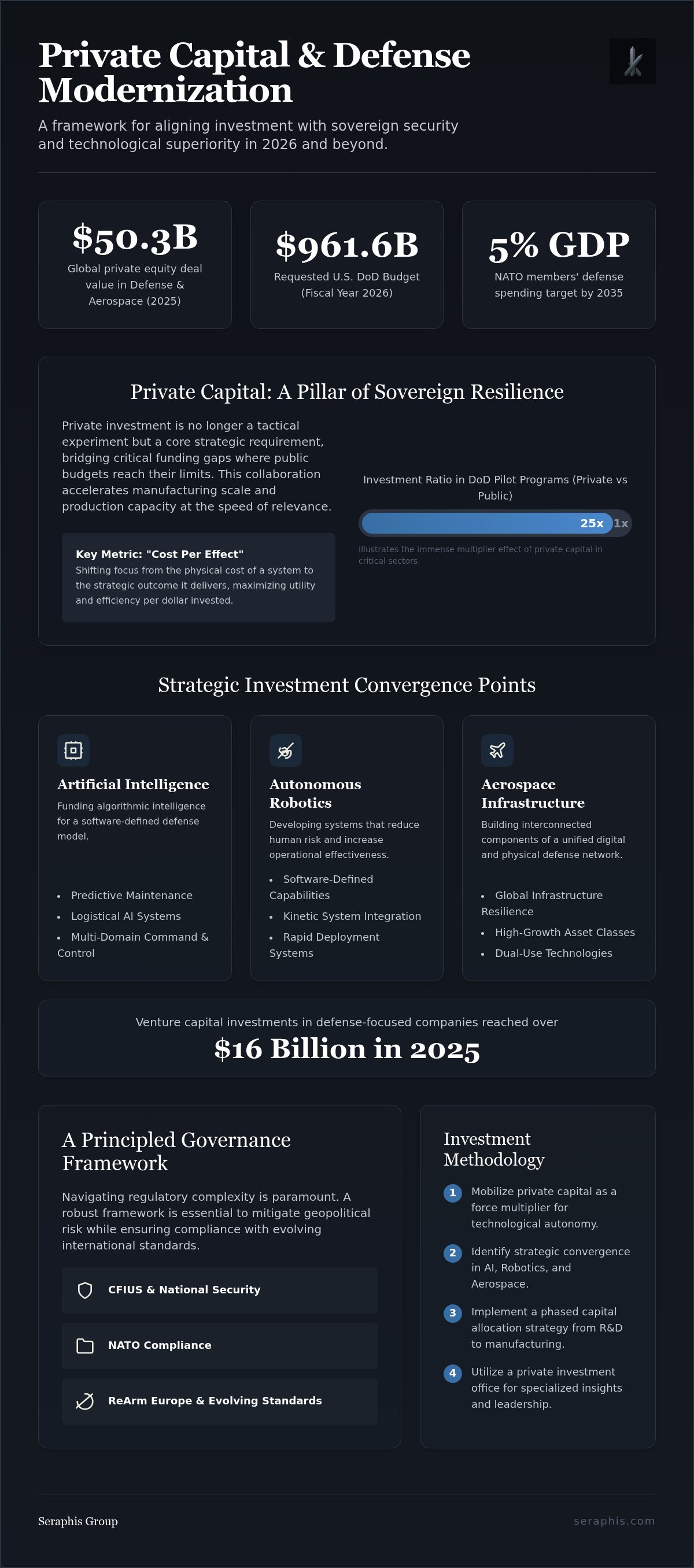
Global private equity deal value in the defense and aerospace sector reached an estimated $50.3 billion in 2025, signaling a permanent shift in the financing of sovereign security. With the U.S. Department of Defense requesting $961.6 billion for fiscal year 2026, the integration of private capital for defense sector modernization has moved beyond tactical experimentation into a core strategic requirement. It's clear that the scale of this opportunity is often matched by the complexity of its execution. Regulatory hurdles like CFIUS and the intricacies of NATO compliance can create significant friction for even the most seasoned institutional investors.
This article provides a rigorous framework for aligning private capital with long-term strategic governance. We'll define the specific characteristics of defense asset classes and address the critical intersection of ethical standards and national security requirements. By the end of this reference, you'll possess a clear methodology for synchronizing investment objectives with the broader goals of sovereign stability and technological superiority.
Key Takeaways
- Understand how the mobilization of private capital for defense sector modernization serves as a critical force multiplier for sovereign security and technological autonomy.
- Identify the strategic convergence points between artificial intelligence, autonomous robotics, and aerospace that are defining the next generation of defense infrastructure.
- Explore an institutional governance framework designed to mitigate geopolitical risk while ensuring compliance with evolving international standards such as NATO and ReArm Europe.
- Learn to implement a phased capital allocation strategy that bridges the gap between early-stage research and development and industrial-scale manufacturing.
- Evaluate the strategic advantages of utilizing a private investment office to secure specialized insights and principled leadership in high-impact defense sectors.
The Evolution of Defense Sector Investment in 2026
The traditional model of defense procurement is undergoing a fundamental structural transition. Historically, the military-industrial complex relied almost exclusively on state-directed funding and long-term government contracts. However, the surge in global private equity deal value, which reached $50.3 billion in 2025, indicates that the private capital for defense sector is now a primary driver of industrial capacity. This evolution marks a transition from speculative venture activity to institutional-grade allocation. Strategic capital is now characterized by its alignment with sovereign defense priorities rather than mere financial arbitrage. It provides the necessary agility for nations to maintain a technological edge in an increasingly volatile environment.
In 2026, the demand for strategic autonomy isn't a peripheral concern. The U.S. DoD budget request of $961.6 billion for 2026, followed by a proposed $1.5 trillion in 2027, underscores a massive expansion in requirements. European nations are similarly recalibrating, with NATO members targeting 5% of GDP spending by 2035. These figures reflect a world where traditional government budgets can't keep pace with the velocity of technological change. This environment necessitates the involvement of a private investment office to provide strategic governance and intellectual rigor. Such entities act as a bridge between high-level policy goals and the operational realities of the defense market.
Bridging the Defense Funding Gap
Modern battlefield outcomes now depend on the rapid deployment of software-defined capabilities and autonomous systems. Traditional procurement cycles, often spanning decades, are inherently mismatched with the lifecycle of modern technology. Investors are increasingly focusing on "cost per effect" as a metric for efficiency. This approach prioritizes the outcome of a system rather than its physical cost. It ensures that private capital for defense sector projects delivers maximum utility per dollar spent, filling the gap where public funding reaches its limits. When budgets are insufficient for rapid scaling, private markets provide the liquidity needed to move from prototype to production at the speed of relevance.
Private Capital as a Pillar of Sovereign Resilience
Aligning private innovation with national security is a prerequisite for sovereign resilience. Private capital doesn't just provide funding; it accelerates manufacturing scale and production capacity in ways that public institutions often struggle to achieve. Dual-use technologies, which serve both commercial and military purposes, have become the cornerstone of this alignment. The 25:1 ratio of private-to-public investment seen in recent Department of Defense pilot programs for critical chemicals illustrates the multiplier effect of this collaboration. By leveraging these synergies, investors achieve resilient returns while supporting the critical infrastructure necessary for global stability and long-term security.
Strategic Focus Areas: AI, Robotics, and Aerospace
The integration of artificial intelligence and kinetic systems represents a fundamental shift toward a software-defined defense model. This transformation is attracting a new profile of institutional investor. In 2025, venture capital investments exceeding $10 million in defense-focused companies reached over $16 billion, illustrating the increasing role of private capital in defense. These investments aren't merely supporting hardware; they're funding the algorithmic intelligence that governs modern conflict. The private capital for defense sector must now evaluate aerospace and robotics not as isolated niches, but as interconnected components of a unified digital infrastructure. This convergence is driving global infrastructure resilience and creating high-growth asset classes that didn't exist a decade ago.
Artificial Intelligence in Modern Defense Systems
Predictive maintenance and logistical AI have emerged as primary investment targets. These systems ensure that equipment remains operational by anticipating failures before they occur, which significantly reduces the logistical tail of military operations. Multi-domain command and control (MDC2) represents another critical area. It integrates data across land, sea, air, space, and cyber domains to facilitate real-time decision-making. Strategic governance ensures these systems operate within established ethical frameworks. Maintaining the balance between machine speed and human oversight is essential for long-term stability and international compliance.
Robotics and Autonomous Infrastructure
The transition from human-centric to machine-augmented defense is most visible in the robotics sector. Scaling the production of high-volume, low-cost autonomous platforms is essential for maintaining strategic depth. These systems also serve a vital role in protecting critical infrastructure, such as energy grids and communication networks. By investing in autonomous robotics, the private capital for defense sector supports a resilient industrial base capable of rapid manufacturing scale-up. Analyzing these complex asset classes requires the sophisticated investment insights provided by a specialized private investment office. This approach ensures that capital is deployed with both precision and a clear understanding of the broader sovereign security landscape.
Institutional Governance and Regulatory Resilience
The regulatory environment governing the private capital for defense sector in 2026 has reached a level of complexity that necessitates a dedicated strategic governance function. Institutional investors must now navigate a multi-layered landscape defined by NATO's 2025 Hague Summit mandates and regional initiatives such as ReArm Europe and the SAFE framework. These structures are designed to harmonize defense procurement across borders while maintaining strict national security oversight. Central to this oversight is the management of Foreign Direct Investment (FDI) and the rigorous scrutiny applied by the Committee on Foreign Investment in the United States (CFIUS). Achieving compliance in this environment requires a granular understanding of private investment in the U.S. defense industrial base, especially considering that private capital activity in these dual-use sectors totaled approximately $440 billion between 2020 and 2024.
Strategic Governance Frameworks
Effective governance for defense-related assets transcends traditional risk management. It requires a framework that balances institutional rigor with the agility necessary for rapid technological innovation. Transparency is paramount. Investors must develop clear protocols for asset oversight that align with the high-stakes nature of the sector. This involves establishing a philosophical alignment between all stakeholders, ensuring that capital deployment serves the long-term stability of the defense ecosystem. By prioritizing strategic governance, a private investment office can mitigate geopolitical risks that transactional models often overlook. This methodical approach ensures that every decision is deliberate and principled.
The Evolving ESG Paradigm in Defense
The intersection of Environmental, Social, and Governance (ESG) standards with national security is undergoing a significant redefinition. In 2026, the "Social" and "Governance" pillars are increasingly interpreted through the lens of regional stability and ethical deterrence. Defense autonomy is recognized as a fundamental contributor to peace, providing the necessary strength to prevent conflict rather than incite it. Addressing ethical alignment concerns requires a shift in perspective. Investors now view the preservation of sovereign security as a primary social responsibility. This evolving paradigm ensures that private capital for defense sector initiatives meets the highest ethical standards while supporting the industrial capacity required for global security.
Capital Allocation Framework for Defense Infrastructure
Successful deployment of private capital for defense sector initiatives requires a tiered approach that respects the unique lifecycle of military hardware and software. Unlike traditional venture capital, defense infrastructure involves long-cycle timelines and significant capital intensity. Allocation must move methodically from research and development into manufacturing scale-up. This necessitates a synthesis of banking discipline and infrastructure expertise to ensure that capital isn't just deployed, but managed with institutional rigor. Investors who prioritize this structured logic can achieve resilient returns while supporting the foundational requirements of sovereign security.
Scaling Industrial Capacity
The defense industrial base currently faces significant bottlenecks in specialized manufacturing and sub-tier supply chains. Private capital plays a vital role in revitalizing these segments by providing the liquidity needed for facility expansion and advanced robotics integration. Identifying these friction points is the first step in building a robust production ecosystem.
- Supply Chain Redundancy: Investing in secondary and tertiary suppliers to prevent single-point failures.
- Advanced Manufacturing: Funding the transition to 3D printing and automated assembly lines for rapid surge capability.
- Specialized Labor: Supporting the infrastructure required to train and retain a highly skilled technical workforce.
Industrial resilience in 2026 is defined as the systemic ability of a nation's production base to sustain output and absorb geopolitical shocks through decentralized, privately-funded manufacturing networks.
Aerospace and Global Infrastructure
Space-based assets have transitioned from a scientific frontier to a fundamental layer of global defense infrastructure. Investing in the resilience of satellite constellations and secure communication networks provides a foundation for all other kinetic and non-kinetic operations. Multi-use aerospace hubs, which serve both commercial and sovereign requirements, offer a stable framework for capital allocation. These hubs benefit from dual-use revenue streams while fulfilling critical national security roles. Strategic capital allocation in this area focuses on long-term infrastructure stability rather than short-term disruption.
Balancing risk-adjusted returns in these sectors requires an understanding of both geopolitical shifts and technical feasibility. Sophisticated investors prioritize projects that offer high barriers to entry and long-term sovereign commitment. To explore how these frameworks apply to your specific objectives, you can access our comprehensive Global Investment Strategy.
Conclusion: The Seraphis Approach to Defense Investment
The alignment of private capital for defense sector requirements demands a partner capable of operating with intellectual rigor and a long-term perspective. Seraphis Group functions as a specialized private investment office, offering a distinct alternative to the transactional nature of traditional brokerage services. By focusing on strategic governance and global investment strategy, we ensure that capital allocation serves both sovereign security goals and institutional objectives. Our approach is defined by a commitment to stability and clarity in an increasingly complex geopolitical environment. It's no longer enough to merely provide access to capital. True value lies in the methodical application of governance to ensure that every investment contributes to a resilient and autonomous defense ecosystem.
Why Strategic Advisory Matters
Strategic advisory is essential when navigating high-impact sectors like AI, robotics, and aerospace. These areas require more than just financial entry; they demand deep sector knowledge and a clear understanding of the regulatory frameworks discussed in previous sections. Seraphis Group leverages this expertise to provide institutional-grade investment insights. We manage sophisticated capital by applying a framework that prioritizes philosophical alignment and high ethical standards. This level of institutional gravity is necessary to mitigate the risks inherent in the defense procurement cycle and large-scale infrastructure projects. Our advisory services bridge the gap between technical innovation and sovereign requirement, ensuring that capital is deployed where it can achieve the greatest strategic effect.
Engaging with the Global Strategist
Our persona is that of a global strategist. We value methodical precision over rushed decision-making. This patient approach allows for the development of transparent governance structures that maximize strategic returns over decades rather than quarters. For institutional partners, the next step involves moving beyond surface-level participation in the defense market. It requires a dedicated advisor who looks at the big picture and operates with a sense of duty. We don't believe in short-term tactical plays that ignore the broader security landscape. Instead, we focus on the foundational principles of organizational management and investment frameworks that define the 2026 defense landscape.
Seraphis Group provides the strategic advisory needed to align private capital for defense sector modernization with sovereign goals. We invite institutional partners to engage with our office for tailored investment insights and a structured path toward defense sector participation. By following a tiered, logical sequence from foundational principles to operational application, we help our partners navigate the complexity of modern defense with understated confidence and global sophistication.
Defining the Next Era of Strategic Defense Allocation
The permanent shift toward private capital dependency within the defense ecosystem reflects a new era of industrial strategy. Achieving resilience in 2026 depends on the seamless integration of autonomous technologies and robust infrastructure under a unified governance framework. This reference has outlined the necessity of aligning private capital for defense sector initiatives with the long-term goals of sovereign autonomy and technological superiority. It's a complex path, but a clear methodology makes it manageable.
Success in these high-impact segments requires a partner that prioritizes institutional gravity and methodical precision. Seraphis Group offers specialized expertise in AI, robotics, and aerospace, providing the strategic advisory needed to manage sophisticated capital with clarity. We invite you to Explore Seraphis Group's Strategic Investment Insights to learn more about our approach to global strategist leadership. The path toward a secure and autonomous future is best navigated with a principled, long-term perspective.
Frequently Asked Questions
What is the role of private capital in the defense sector in 2026?
Private capital serves as a critical force multiplier that enables the rapid scaling of the defense industrial base. In 2026, it bridges the gap between traditional procurement cycles and the velocity of modern technological advancement. By providing the liquidity needed for facility expansion and R&D, the private capital for defense sector ensures that sovereign security requirements are met with agility. This involvement is no longer peripheral; it's a foundational pillar of national industrial resilience.
How does strategic governance impact defense sector investment returns?
Strategic governance acts as a primary tool for risk mitigation in volatile geopolitical environments. By implementing rigorous oversight and transparent protocols, investors can navigate the complexities of long-cycle aerospace and infrastructure projects more effectively. This structured approach helps in identifying potential friction points early, ensuring that capital deployment remains aligned with both ethical standards and sovereign goals. Ultimately, strong governance enhances the stability of returns by reducing exposure to regulatory and political shifts.
Can private capital invest in dual-use technologies like AI and robotics?
Private capital is increasingly directed toward dual-use technologies such as artificial intelligence and autonomous robotics. These sectors offer high growth potential because their applications span both commercial infrastructure and national security requirements. In 2025, venture capital investments in defense-focused companies exceeded $16 billion, reflecting this trend. Investors prioritize these assets because they provide diverse revenue streams and benefit from the rapid innovation cycles typical of the private technology sector. The private capital for defense sector focuses heavily on these convergence points.
What are the regulatory hurdles for private capital in defense (CFIUS, NATO)?
Investors must manage significant scrutiny from the Committee on Foreign Investment in the United States (CFIUS) and similar regional bodies. Compliance with NATO's evolving spending mandates and the SAFE framework is also mandatory. These hurdles require a sophisticated understanding of international law and national security priorities. Navigating these reviews successfully involves establishing clear transparency in ownership and demonstrating a long-term commitment to the stability of the defense industrial base and its critical infrastructure components.
How has the ESG perspective on defense investment changed recently?
The ESG paradigm has evolved to recognize that national security is a prerequisite for social and environmental progress. In 2026, defense autonomy is increasingly viewed as an ethical deterrent that prevents conflict and maintains regional stability. This shift allows institutional investors to align their portfolios with broader social responsibilities without compromising on the necessity of sovereign protection. Governance standards now prioritize the preservation of peace through the maintenance of technological and industrial superiority across global markets.
What is the difference between a private investment office and a retail brokerage in defense?
A private investment office like Seraphis Group provides specialized strategic advisory and institutional-grade governance tailored to high-impact sectors. In contrast, a retail brokerage typically focuses on providing transactional access to public markets for individual investors. Seraphis Group doesn't offer retail brokerage services, personal financial planning, or publicly traded mutual funds. Instead, the firm prioritizes methodical precision and deep sector knowledge in AI, robotics, and aerospace to support sophisticated capital management for institutional partners.
How does Seraphis Group approach capital management in high-impact sectors?
Seraphis Group implements a global investment strategy characterized by intellectual rigor and methodical precision. The firm focuses on providing strategic insights that go beyond simple capital deployment. By prioritizing philosophical alignment and transparent governance, Seraphis ensures that every investment in the defense or technology sectors is deliberate. This approach allows for the effective management of complex assets in aerospace and critical infrastructure while maintaining a clear focus on long-term sovereign security goals and principled leadership.
Is defense sector investment suitable for long-term institutional portfolios?
Defense sector assets are well-suited for institutional portfolios due to their long lifecycles and the consistent nature of sovereign demand. These investments provide a level of stability that is often decoupled from broader market cycles. With the U.S. DoD requesting $961.6 billion for 2026, the sector demonstrates a high degree of long-term commitment from government stakeholders. The integration of private capital for defense sector infrastructure offers a resilient asset class for those seeking strategic, high-impact growth and risk-adjusted returns.


