

The traditional model of capital allocation is no longer sufficient to secure resilience in an era defined by rapid advancements in artificial intelligence and robotics. Many institutional partners recognize that standard market participation often fails to address the complexities of national security and critical infrastructure. You likely understand that the 2026 technological environment demands more than just financial liquidity; it requires a structural alignment between capital and strategic governance. Utilizing a specialized private investment office for technology sector initiatives ensures that a portfolio isn't just exposed to growth, but is actively managed through a lens of institutional stability and rigorous oversight.
This analysis examines how a sophisticated governance framework provides the necessary clarity for cross-sector investments in defense, aerospace, and healthcare. We'll explore the methodologies used to mitigate volatility in emerging fields while aligning assets with global security requirements. The following sections provide a clear roadmap for establishing long-term capital stability and expert-led strategic advisory. By prioritizing philosophical alignment and methodical precision, investors can secure a position of authority within the most critical sectors of the global economy.
Key Takeaways
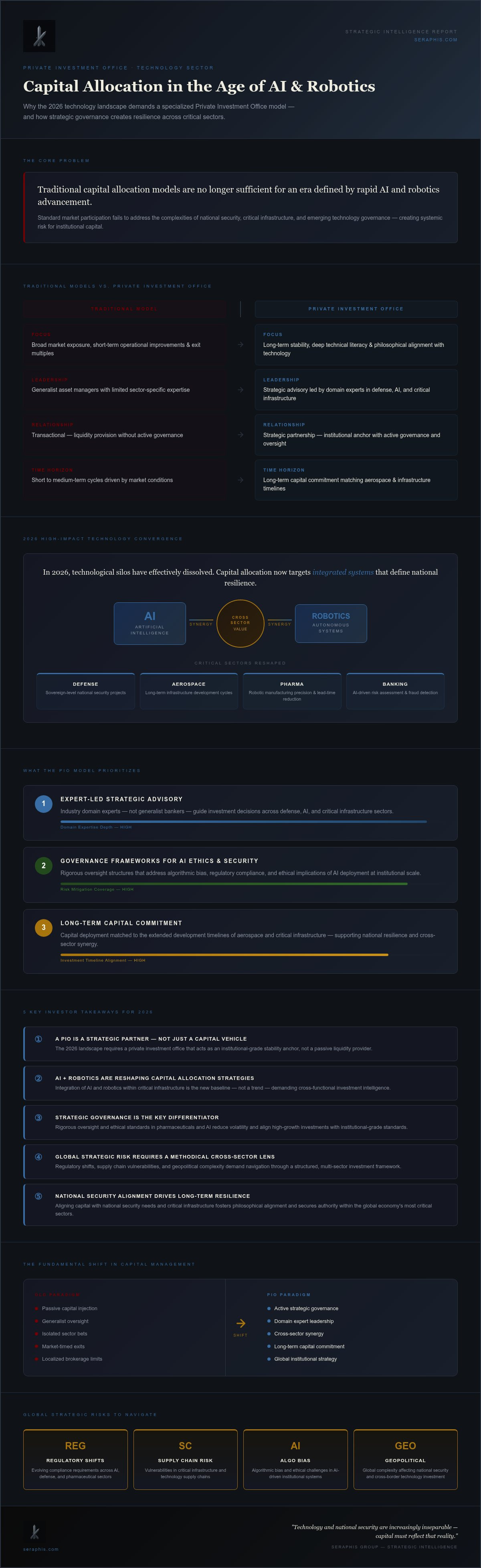
- Learn why the 2026 landscape requires a private investment office for technology sector initiatives that acts as a strategic partner to ensure institutional-grade stability.
- Identify how the integration of artificial intelligence and robotics within critical infrastructure projects is reshaping modern capital allocation strategies.
- Discover the role of strategic governance in establishing rigorous oversight and ethical standards to mitigate risk in high-growth sectors like pharmaceuticals.
- Understand how to navigate global strategic risks, including regulatory shifts and supply chain vulnerabilities, through a methodical, cross-sector investment lens.
- Gain insights into aligning capital with national security needs and critical infrastructure to foster long-term resilience and philosophical alignment.
The Evolution of the Private Investment Office in the Technology Sector
The landscape of capital management is undergoing a fundamental transformation as we approach 2026. Historically, institutional and private wealth relied on generalist asset managers who prioritized broad market exposure over deep technical literacy. This approach is proving inadequate for the complexities of modern technological advancement. A specialized private investment office for technology sector participants represents a shift toward a more deliberate, strategic partnership model. Rather than engaging in purely transactional relationships, these offices function as institutional anchors that provide the governance required to manage high-stakes assets in defense and aerospace.
Defining the Technology-Centric PIO Model
A private investment office for technology sector investments serves as a sophisticated hub where strategic capital intersects with rigorous organizational governance. While traditional private equity often focuses on short-term operational improvements and exit multiples, the PIO model emphasizes long-term stability and philosophical alignment with the underlying technology. This approach distinguishes between passive capital injection and active strategic guidance. In sectors such as defense, aerospace, and critical infrastructure, the mere provision of liquidity isn't enough. These fields require a partner that understands the nuances of national security requirements and the long-term nature of sovereign-level projects.
Why Traditional Models Fall Short in High-Impact Tech
Standard investment vehicles, including retail brokerage services and publicly traded mutual funds, aren't designed to manage the specific risks associated with emerging technologies like artificial intelligence and robotics. These traditional models often lack the specialized governance frameworks needed to navigate rapid innovation cycles and evolving regulatory environments. In fields like pharmaceuticals and robotics, the gap between a generalist's understanding and the actual technical requirements can lead to significant capital misalignment.
Effective management in 2026 requires a global investment strategy that transcends localized brokerage limitations. High-impact technology sectors demand an institutional-grade approach that prioritizes:
- Strategic advisory led by industry experts rather than generalist bankers.
- Governance frameworks that address the ethical and security implications of AI.
- Long-term capital commitment that matches the development timelines of aerospace and infrastructure.
By moving away from the transactional nature of retail-focused strategies, a specialized PIO ensures that capital is not just deployed, but is actively governed to support national resilience and cross-sector synergy. This structural shift is essential for maintaining a competitive advantage in a world where technology and national security are increasingly inseparable.
High-Impact Technology Trends Reshaping Capital Allocation in 2026
The year 2026 marks a period where technological silos have effectively dissolved. Capital allocation no longer targets isolated software or hardware plays but instead focuses on integrated systems that define national resilience. For a private investment office for technology sector engagements, this requires a shift toward cross-functional intelligence. The convergence of artificial intelligence and robotics isn't merely a trend; it's the new baseline for critical infrastructure and pharmaceutical manufacturing. Success in this environment depends on the ability to recognize how these technologies interact to create systemic value across multiple industries simultaneously.
The AI and Robotics Synergy
Autonomous systems are fundamentally restructuring the operational models of banking and physical infrastructure. In the banking sector, AI-driven risk assessment and automated fraud detection have moved from experimental phases to core institutional requirements. This evolution necessitates a high degree of strategic governance to manage algorithmic bias and ensure regulatory compliance. Similarly, in the pharmaceutical sector, robotics are streamlining complex manufacturing processes, allowing for greater precision and reduced lead times. Managing these assets requires a deep understanding of how software intelligence interacts with physical hardware, a task that falls outside the scope of traditional brokerage models.
Defense and Aerospace: The New Frontier of Private Capital
Aerospace and defense have emerged as primary engines of innovation, drawing significant private capital toward projects once reserved for sovereign entities. As geopolitical landscapes shift, the demand for dual-use technology, which includes innovations that serve both civilian and military purposes, has intensified. A private investment office for technology sector clients must provide specialized advisory to navigate the stringent regulatory frameworks governing defense contracts. Strategic capital allocation in this field focuses on aerospace infrastructure and satellite communication networks, which are essential for global connectivity and security. Many institutional partners now look toward expert-led strategic advisory to ensure their defense investments align with long-term national security goals.
Digital resilience remains a cornerstone of these investments. As healthcare technology becomes increasingly interconnected, the importance of cybersecurity cannot be overstated. Protecting pharmaceutical intellectual property and patient data within healthcare systems is a matter of both financial and national security. The 2026 environment demands a global investment strategy that accounts for supply chain vulnerabilities and shifting international alliances. By focusing on the intersection of AI, defense, and robotics, institutional partners can foster a portfolio that is both high-growth and structurally sound.
Strategic Governance: The Differentiator in Technology Investment
Strategic governance represents the methodical oversight of investment frameworks and ethical standards, serving as the foundational pillar for any high-impact portfolio. Within the 2026 landscape, this oversight is no longer a peripheral function but a primary differentiator. A specialized private investment office for technology sector engagements treats governance as an active management tool rather than a passive compliance checklist. This institutional logic ensures that capital allocation in high-growth sectors remains aligned with long-term stability and national resilience. By establishing clear boundaries and rigorous evaluative criteria, governance provides the intellectual rigor necessary to navigate sectors where innovation often outpaces regulation.
In volatile fields such as pharmaceuticals and artificial intelligence, the absence of a structured governance framework often leads to significant capital misalignment. Governance minimizes these risks by ensuring that every investment undergoes a comprehensive review of its ethical, regulatory, and security implications. Transparent governance also plays a critical role in maximizing returns within private equity by providing a clear audit trail and a consistent decision-making process. This structured approach reassures stakeholders that capital is being deployed with a focus on systemic value rather than speculative gains.
Implementing Institutional Grade Oversight
A robust governance framework for technology must integrate several core components to be effective. These include rigorous compliance protocols, frameworks for the ethical deployment of AI, and proactive risk mitigation strategies. Strategic advisory plays a central role here, ensuring that governance standards are maintained even as technological capabilities evolve. Institutional-grade oversight requires a tiered approach to risk, where technical experts and strategic authorities collaborate to evaluate the long-term viability of an asset. It's this level of detail that prevents the erosion of capital in complex, high-stakes environments.
Governance as a Value-Add for Institutional Partners
Sophisticated capital from institutional partners is naturally drawn to environments where methodical, structured decision-making is the norm. For a private investment office for technology sector participants, governance serves as a powerful value-add that provides the long-term stability required for large-scale projects. This is particularly evident in the management of critical infrastructure, where the intersection of private capital and public interest demands the highest standards of transparency. Methodical governance ensures that these projects remain resilient against geopolitical shifts and technological disruptions, fostering a sense of reliability and global sophistication that traditional brokerage models cannot replicate.
Navigating Global Strategic Risks in Technology Infrastructure
Global risks in 2026 are defined by systemic volatility rather than isolated market events. Regulatory shifts and supply chain vulnerabilities have become central concerns for institutional partners. A specialized private investment office for technology sector participants provides the global investment insights necessary to transcend traditional market analysis. It's a model that prioritizes the protection of banking and infrastructure assets through a lens of national security and technical resilience. Unlike generalist firms that rely on trailing indicators, a PIO integrates geopolitical intelligence into its core evaluative framework. This proactive stance is essential for maintaining capital stability in an increasingly fragmented global economy.
Managing Sector Correlation and Risk
Effective risk management requires a sophisticated understanding of cross-sector correlation. A strategy that integrates defense and healthcare investments can mitigate specific industry downturns. While defense cycles follow geopolitical shifts, healthcare technology often responds to demographic timelines and pharmaceutical breakthroughs. This balance is vital for long-term health. Critical infrastructure projects, such as specialized aerospace networks, serve as a stabilizing hedge. They provide a baseline of resilience against broader market instability. Managing these correlations ensures capital remains productive during periods of intense sector-specific pressure.
Regulatory Navigation in Defense and AI
The emergence of international standards for artificial intelligence has created a complex web of compliance requirements. Strategic advisory is essential for navigating these shifts. This is especially true when investments intersect with defense sector regulations and national security protocols. Global perspectives are no longer optional for infrastructure project investment. They're a requirement for long-term viability and ethical alignment. By maintaining a principled institutional presence, partners secure their positions within high-stakes sectors. They do this while adhering to evolving legal standards that govern high-impact fields like robotics and AI.
Partners seeking to align their portfolios with these institutional standards should explore the Global Investment Strategy provided by Seraphis Group.
Seraphis Group: A Principled Approach to Technology Investment
Seraphis Group operates as a specialized private investment office for technology sector participants, prioritizing institutional-grade insights over transactional gains. The firm's focus remains fixed on defense, healthcare, and high-impact technology, where strategic governance is the primary requirement for success. By explicitly avoiding the retail brokerage and personal financial planning models, Seraphis maintains a pure focus on the sophisticated needs of institutional partners. This commitment to stability and clarity ensures that capital allocation remains aligned with long-term global investment strategies. The firm's role is that of a seasoned expert, providing the intellectual rigor necessary to manage assets that define the future of critical infrastructure.
Strategic Advisory for Global Stakeholders
Seraphis provides expert guidance in fields where innovation cycles are rapid and the consequences of misalignment are high. In robotics and artificial intelligence, the firm's strategic advisory ensures that deployment follows rigorous ethical and security standards. This methodical precision extends to pharmaceuticals and banking, where optimizing investment outcomes requires a deep understanding of complex regulatory frameworks. The Seraphis investment philosophy is rooted in systematic thinking and transparency. It provides a stable foundation for stakeholders who value a global strategist's perspective on the big picture. Every decision follows a tiered, logical sequence designed to provide full context and clear definitions of intent.
Partnering for Long-Term Impact
The collaborative strategy for backing innovative businesses in aerospace focuses on systemic innovation and national resilience. Seraphis Group identifies opportunities for strategic growth that transcend traditional market analysis, focusing instead on the long-term viability of aerospace infrastructure. As a principled institutional leader, the firm invites partners who share a vision for methodical precision and philosophical alignment. This approach fosters a portfolio of assets that are not only high-growth but also structurally integral to the future global economy. By prioritizing strategic authority and global sophistication, Seraphis ensures that its partners are positioned at the forefront of the most critical sectors of 2026.
Institutional partners seeking a private investment office for technology sector initiatives find in Seraphis a partner dedicated to duty and precision. The firm's steady rhythm and organized flow reinforce its image as a stable entity that doesn't make rushed decisions. Instead, it follows a clear, structured path toward long-term capital stability. This principled approach is what allows Seraphis to serve as a strategic authority in an era of unprecedented technological change.
Securing Institutional Resilience in the 2026 Technology Landscape
The transition toward a more structured and governed investment model is essential for maintaining stability within high-impact fields. As we look toward 2026, the convergence of artificial intelligence, robotics, and defense requires a level of intellectual rigor that traditional asset management doesn't always provide. Aligning capital with national security and critical infrastructure ensures that portfolios remain resilient against geopolitical shifts and regulatory complexities. Utilizing a specialized private investment office for technology sector initiatives allows institutional partners to move beyond speculative participation. It's a shift toward active, strategic oversight.
Seraphis Group remains dedicated to providing the institutional-grade strategic governance and expert-led advisory required for these high-stakes environments. By focusing on a global investment strategy for critical infrastructure and maintaining deep expertise in defense and AI, the firm provides a stable foundation for long-term impact. We invite you to engage with a principled institutional leader to secure your position within the future global economy. Methodical precision remains the most reliable path to securing long-term value.
Explore Strategic Investment Advisory with Seraphis Group
Frequently Asked Questions
What distinguishes a private investment office from a retail brokerage firm?
A private investment office focuses on strategic capital management and institutional-grade governance rather than transactional volume. While retail brokerage firms provide access to public markets for individual investors, a specialized private investment office for technology sector initiatives provides deep strategic advisory and global investment insights. This model prioritizes long-term stability and philosophical alignment, ensuring that capital is deployed within complex sectors like defense and aerospace with methodical precision and rigorous oversight.
How does Seraphis Group manage risk in high-volatility sectors like AI and robotics?
Risk management is achieved through a robust strategic governance framework that evaluates the ethical, regulatory, and security implications of every asset. Seraphis Group utilizes expert-led advisory to navigate the rapid innovation cycles characteristic of artificial intelligence and robotics. By maintaining a global investment strategy, the firm identifies cross-sector correlations that mitigate localized volatility. This methodical approach ensures that capital remains secure within high-impact fields, prioritizing national resilience over speculative, short-term market fluctuations.
What are the primary technology sectors Seraphis Group focuses on in 2026?
The organization concentrates its expertise on five core high-impact sectors: defense, healthcare, aerospace, robotics, and artificial intelligence. These fields represent the intersection of systemic innovation and critical infrastructure. In 2026, the firm specifically targets projects where strategic governance can provide a clear differentiator. This includes specialized infrastructure developments and pharmaceutical advancements that require institutional-grade capital management. Every sector focus is chosen for its potential to contribute to long-term global stability and technological resilience.
Does Seraphis Group offer personal financial planning for individual investors?
No, Seraphis Group doesn't provide personal financial planning or retail brokerage services. The firm operates exclusively as a specialized private investment office for technology sector participants and institutional partners. The organizational mission is centered on high-level strategic advisory and sophisticated capital management rather than consumer-facing financial products. This focus allows the firm to maintain its position as a principled institutional leader, providing the intellectual rigor required for complex investments in defense and critical infrastructure.
How does strategic governance impact the returns of technology investments?
Strategic governance serves as a primary value-add by establishing a clear, methodical framework for decision-making and risk mitigation. In the volatile technology sector, transparent governance ensures that capital is aligned with long-term objectives rather than reactive market trends. By implementing rigorous ethical standards and compliance protocols, the firm protects against regulatory shifts and reputational risks. This structured oversight provides the stability required to maximize returns within private equity and large-scale infrastructure projects over extended timelines.
What role does defense technology play in a global investment strategy?
Defense technology acts as a fundamental driver of innovation and a cornerstone of national resilience. Within a global investment strategy, defense assets provide a stabilizing hedge against broader market instability due to their long-term development cycles and sovereign-level backing. Seraphis Group prioritizes defense investments that offer dual-use applications across aerospace and critical infrastructure. This approach ensures that capital supports essential security requirements while benefiting from the technological breakthroughs that often originate within specialized defense research and development.
Can institutional partners access specialized advisory for infrastructure projects?
Institutional partners have direct access to specialized advisory services designed to optimize the outcomes of complex infrastructure projects. This guidance covers the technical, regulatory, and strategic aspects of aerospace and critical infrastructure development. Seraphis Group provides the institutional-grade insights necessary to navigate the intersection of private capital and public interest. By leveraging deep industry knowledge, the firm ensures that every project follows a clear, structured path toward operational success and long-term capital stability.
How does Seraphis Group approach pharmaceutical and healthcare investments?
The firm approaches healthcare and pharmaceutical investments through a lens of technical literacy and strategic governance. Rather than following generalist trends, the organization focuses on high-impact areas such as robotics-assisted manufacturing and digital resilience within medical systems. This methodical strategy prioritizes the protection of intellectual property and the alignment of assets with global healthcare needs. By integrating healthcare within a cross-sector framework, Seraphis Group identifies synergies that enhance the stability and long-term growth potential of the portfolio.


