

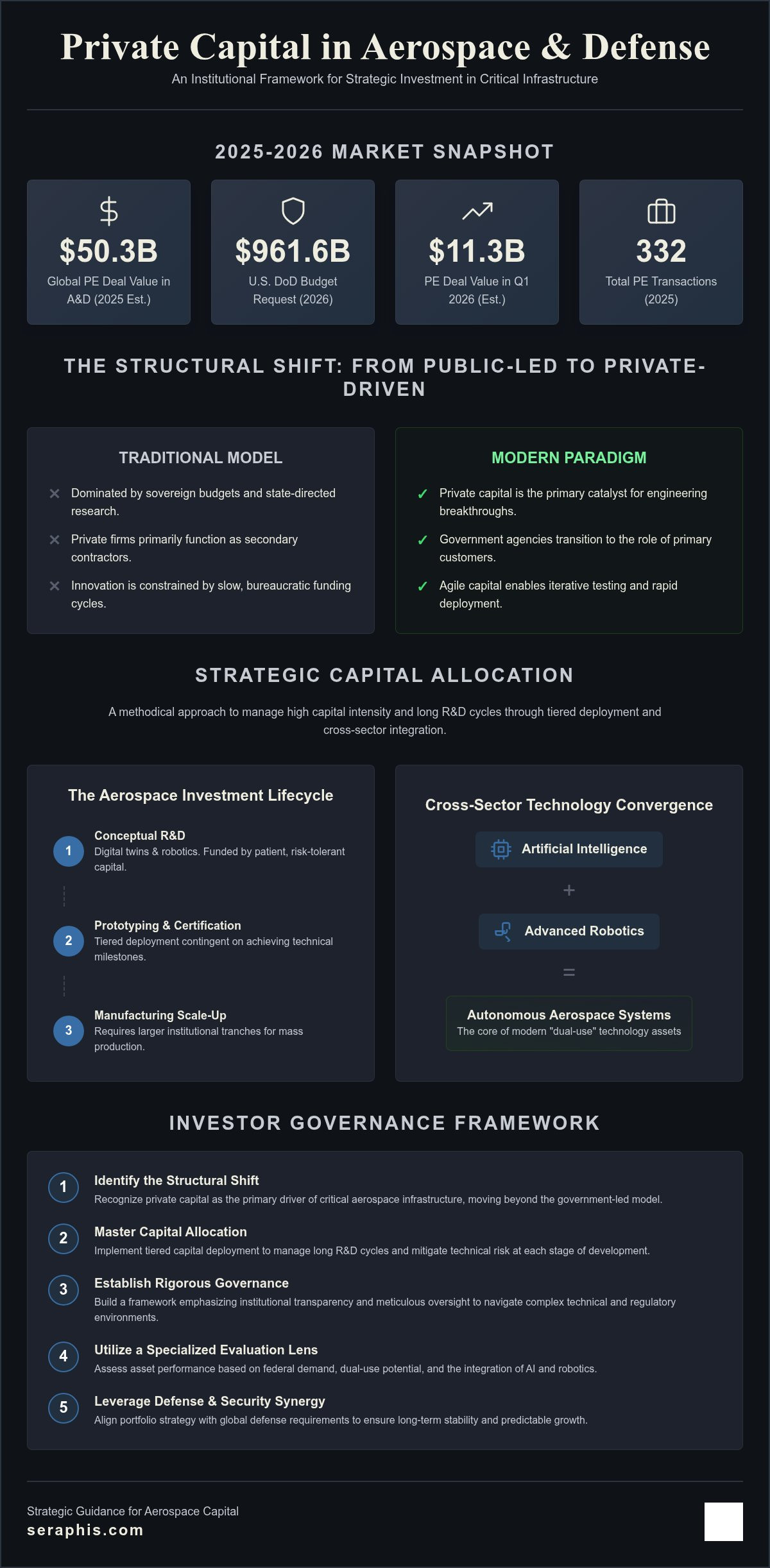
Global private equity deal value in the aerospace and defense sector reached an estimated $50.3 billion in 2025, marking a significant era for institutional participation. As the U.S. Department of Defense requests $961.6 billion for its 2026 budget, the demand for private capital for aerospace technology is no longer a peripheral concern but a fundamental component of global infrastructure. You likely recognize that the traditional barriers, such as high capital intensity and opaque regulatory environments, often obscure the path to sustainable returns. It's difficult to align these multi-decade R&D cycles with the rapid pace of other high-tech sectors like artificial intelligence.
This article provides an institutional-grade framework designed to demystify the mechanisms of aerospace asset evaluation and strategic governance. We'll examine how the convergence of artificial intelligence, robotics, and aerospace creates a unique investment landscape that requires methodical precision. By establishing a clear logic for capital allocation, you can better manage technical risks while positioning your portfolio at the center of the evolving global security and infrastructure economy.
Key Takeaways
- Identify the structural shift from government-led development to a landscape where private capital for aerospace technology functions as a primary driver of critical infrastructure.
- Analyze the mechanisms of strategic capital allocation to manage the high intensity of aerospace research and development cycles effectively.
- Establish a governance framework that emphasizes institutional transparency and rigorous oversight to mitigate the technical risks inherent in aerospace investments.
- Utilize a specialized evaluation checklist to assess asset performance through the lens of federal demand and the integration of artificial intelligence and robotics.
- Recognize the strategic synergy between aerospace and global defense requirements to ensure long-term portfolio stability and growth.
The Evolution of Private Capital for Aerospace Technology
The current aerospace market represents a fundamental realignment of how high-stakes innovation is financed and governed. While the sector once relied almost exclusively on sovereign budgets and state-directed research, the landscape in 2026 demonstrates that private capital for aerospace technology has become the primary catalyst for engineering breakthroughs. This shift isn't merely a change in funding sources; it's a structural transformation in how risk is managed and how governance is applied to what's now classified as critical infrastructure. As global private equity deal value in the sector reached an estimated $50.3 billion in 2025, the role of the private investment office has transitioned from a passive participant to a strategic authority.
The Shift from Public to Private Funding Models
Historically, the relationship between public and private sectors in aerospace was defined by government-led research and development (R&D) with private firms acting as contractors. Today, the rise of "New Space" and autonomous aviation has inverted this model. Private firms now lead the charge in propulsion, satellite constellations, and robotics. Government agencies have transitioned into the role of primary customers rather than sole architects. This acceleration in engineering is driven by the agility of private capital, which allows for iterative testing and faster deployment cycles than traditional bureaucratic funding. In the first quarter of 2026 alone, private equity deal value reached an estimated $11.3 billion, illustrating a robust appetite for assets that were once considered the exclusive domain of the state.
Aerospace as a High-Impact Investment Sector
Aerospace technology is now firmly classified as critical infrastructure, directly correlating with global security and economic stability. The sector functions as a massive economic multiplier; innovations in aerospace frequently provide the foundational technology for advancements in materials science, AI, and global logistics. Analyzing the correlation between aerospace and global security reveals that private capital for aerospace technology is essential for maintaining a competitive edge in a fragmented geopolitical environment.
The institutional logic for this allocation rests on long-term value creation rather than short-term market volatility. While other high-tech sectors may experience rapid cycles of hype and correction, the aerospace sector rewards methodical precision and principled governance. This stability is reinforced by record-breaking defense budget requests, such as the $961.6 billion U.S. DoD request for 2026, which ensures a predictable pipeline for dual-use technologies. By integrating global investment strategy with a focus on these high-impact assets, investors can achieve a level of portfolio resilience that is difficult to replicate in less specialized sectors.
Mechanisms of Strategic Capital Allocation in Aerospace
Allocating private capital for aerospace technology requires a nuanced understanding of the sector's unique capital intensity. Unlike software-centric investments, aerospace R&D involves physical prototyping, rigorous safety certifications, and long lead times for manufacturing scale. In 2025, private equity transactions in this sector reached a record 332 deals, reflecting a growing institutional recognition of this asset class. Success in this environment depends on a strategic synergy between defense and civilian applications. By targeting "dual-use" technologies, investors can stabilize cash flows while leveraging the $961.6 billion U.S. DoD budget request for 2026.
Managing the Aerospace Product Lifecycle
The investment journey typically moves from conceptual robotics and digital twins to full orbital deployment. Each stage demands a specific capital structure. Early-stage prototyping requires patient, risk-tolerant funding, whereas manufacturing scale-up often necessitates larger institutional tranches. Tiered capital deployment acts as a primary risk mitigation tool, ensuring that additional funding is contingent upon meeting technical milestones. This methodical approach to strategic investment in the space sector helps investors manage the volatility inherent in high-engineering environments.
Cross-Sector Synergies: AI, Robotics, and Aerospace
Modern aerospace systems are essentially autonomous robots operating in extreme conditions. The convergence of AI and aerospace technology has shifted the value proposition from hardware alone to the software and data integration within the platform. This synergy is particularly evident in three areas:
- Autonomous Navigation: AI-driven systems reduce the need for constant human intervention in satellite operations and drone swarms, lowering operational costs.
- Predictive Maintenance: Robotics integrated with AI sensors allow for real-time monitoring of airframe health, extending the lifecycle of expensive assets.
- Governance Alignment: The ethical and operational standards used in AI investment governance provide a reliable template for evaluating aerospace software safety and reliability.
Managing liquidity in these long-lifecycle projects requires a global perspective. Fragmented markets, particularly in the supply chains where venture capital accounted for 85% of 2025 transactions, offer significant opportunities for consolidation. By applying a global investment strategy, a private investment office can identify undervalued components of the aerospace industrial base that are critical to future infrastructure. This institutional logic ensures that private capital for aerospace technology remains a stable, long-term driver of growth and technological sovereignty.
Strategic Governance Frameworks for Private Investment
Effective deployment of private capital for aerospace technology necessitates a governance structure that transcends standard venture oversight. In a sector where defense-specific transactions increased by nearly 400% year-over-year in early 2026, the complexity of managing dual-use assets requires rigorous institutional gravity. Unlike traditional tech sectors, aerospace demands a long-term perspective where governance isn't just about financial reporting but about technical and ethical stewardship. A private investment office acts as a principled authority, ensuring that capital allocation aligns with both global security requirements and institutional ethical standards.
Institutional Logic in Aerospace Governance
Investment governance in this sector must be tiered and methodical. Structuring board-level oversight for technical assets involves more than just oversight of the balance sheet; it requires a deep understanding of engineering lifecycles and geopolitical shifts. As NATO targets lifting defense spending toward 5% of GDP by 2035, strategic advisory becomes essential for managing the risks associated with international cooperation and export controls. Transparent governance provides the stability necessary to reassure stakeholders that high-impact investments are managed with intellectual rigor and global sophistication.
Risk Management and Technical Resilience
Evaluating engineering milestones is a core component of technical resilience. Regulatory and compliance bottlenecks, such as those found in ITAR or international space law, can stall projects if not managed with foresight. Private capital for aerospace technology must be supported by frameworks that anticipate these hurdles. Digital resilience is also paramount. As aerospace infrastructure becomes increasingly reliant on AI and cloud-based systems, ensuring the integrity of the data pipeline is a non-negotiable aspect of modern governance. This methodical precision ensures that the firm doesn't make rushed decisions, instead following a clear, structured path toward long-term asset stability.
Ethical standards and compliance in defense-related aerospace are particularly critical. With the U.S. DoD budget request hitting $961.6 billion for 2026, the volume of capital flowing into the sector demands high-level strategic governance. Investors must navigate the ethical implications of autonomous systems and dual-use technologies with transparency. By implementing institutional-grade investment insights, a private investment office provides the strategic oversight needed to correlate aerospace with other high-tech sectors while maintaining the highest levels of professional integrity.
Evaluating Aerospace Assets: An Investor Checklist
Allocating private capital for aerospace technology requires a rigorous due diligence process that balances technical feasibility with sovereign demand. In an environment where the U.S. Department of Defense has requested $961.6 billion for the 2026 fiscal year, the ability to distinguish between speculative engineering and scalable defense solutions is paramount. Investors must move beyond the "hype" often associated with venture-backed space ventures to focus on institutional-grade metrics. This evaluation checklist ensures that capital is deployed into assets with a verifiable technical moat and a clear path to integration within the global security infrastructure.
Quantitative vs. Qualitative Asset Evaluation
Quantitative metrics in aerospace differ fundamentally from traditional technology sectors. While revenue growth remains important, R&D efficiency and patent velocity serve as more accurate predictors of long-term viability. Investors should analyze the contract backlog specifically for firm-fixed-price government agreements, as these indicate a transition from experimental phases to operational reliability. Financial modeling for long-term orbital and aviation assets must also account for the capital intensity of manufacturing scale. It's not enough to have a functional prototype; the firm must demonstrate a clear strategy for supply chain resilience, particularly within the fragmented tier-two and tier-three layers where consolidation opportunities are most prevalent.
The Role of Strategic Advisory in Due Diligence
Qualitative assessment involves evaluating the integration potential of artificial intelligence and robotics within the aerospace platform. A technical moat is often defined by the complexity of the software-hardware interface. If a company's robotics backbone isn't optimized for autonomous navigation or predictive maintenance, its long-term value may be limited. Strategic advisory plays a critical role here by identifying "hidden" infrastructure dependencies, such as reliance on specialized materials or specific satellite constellations. Identifying these bottlenecks early prevents capital from being trapped in projects that lack the necessary ecosystem to thrive.
Management expertise is the final, non-negotiable component of the checklist. The leadership team must possess a deep understanding of the regulatory landscape, including ITAR compliance and international space law. Without this specialized knowledge, even the most advanced technology can face insurmountable hurdles. For those seeking to navigate these complexities with methodical precision, accessing professional investment insights is an essential step in refining a global investment strategy. This institutional logic ensures that every allocation is supported by a comprehensive understanding of both technical risk and federal demand pipelines.
Seraphis Group: Strategic Guidance for Aerospace Capital
Seraphis Group operates as a private investment office dedicated to the methodical management of capital within high-impact sectors. In an era where private capital for aerospace technology is essential for global infrastructure, our firm provides the institutional gravity required to navigate these long-lifecycle projects. We don't act as a retail brokerage. Instead, we offer a specialized perspective that values strategic governance over speculative market movements. This approach ensures that sophisticated stakeholders receive the clarity necessary for long-term capital preservation and growth within an increasingly complex regulatory environment.
The Seraphis Methodology: Stability and Clarity
The Seraphis methodology is rooted in stability and intellectual rigor. Applying a global investment strategy allows our team to consider the macro-economic and geopolitical implications of aerospace assets alongside technical performance. Intellectual rigor is necessary because aerospace technology cannot be evaluated in isolation; it represents the intersection of defense, AI, and robotics. Our role is that of a global strategist. Our team looks at the big picture to ensure that every capital allocation follows a deliberate and principled path. This methodical sequence reinforces our image as a stable entity that prioritizes thorough analysis of supply chain resilience and technical moats over rushed, hype-driven decisions.
Partnering for Strategic Growth
A specialized investment partner is essential for managing the technical and regulatory risks inherent in aerospace and defense. Our services include strategic advisory designed for sophisticated capital. By aligning technical milestones with institutional-grade investment insights, we optimize outcomes for projects involving autonomous systems and dual-use technologies. While our expertise extends to healthcare, pharmaceuticals, and critical infrastructure, our focus on aerospace provides a unique vantage point for managing technical risk. We explicitly do not offer publicly traded mutual funds or personal financial planning. Institutional focus remains strictly on the high-level governance of private assets and the integration of advanced robotics.
Sophisticated investors require a partner that values philosophical alignment and methodical precision. Inquire about our Strategic Investment Advisory to understand how we can support your long-term objectives in the evolving aerospace sector through principled leadership and global strategic insights.
Advancing Strategic Governance in the Aerospace Economy
The transition of aerospace from a state-led endeavor to a sector driven by private capital for aerospace technology represents a fundamental shift in global infrastructure. Managing these assets requires more than a simple financial allocation; it demands a rigorous evaluation of technical moats and a deep understanding of federal demand cycles. By prioritizing institutional governance and methodical precision, investors can mitigate the inherent risks of long-lifecycle engineering while capitalizing on the convergence of AI and robotics. This alignment ensures that capital serves as a stable driver of technological sovereignty.
Seraphis Group provides the stable, strategic authority necessary to navigate this complex landscape. Our institutional-grade methodology and specialized expertise in defense and AI ensure that your global investment strategy remains aligned with the highest standards of transparency and intellectual rigor. We invite you to Explore Seraphis Group Institutional Investment Insights to refine your approach to high-impact infrastructure. It's a deliberate process, and we're prepared to guide that journey with methodical clarity and a focus on long-term resilience.
Frequently Asked Questions
What is the role of private capital in aerospace technology in 2026?
Private capital acts as the primary catalyst for engineering breakthroughs and infrastructure development. It provides the financial agility needed for iterative testing that sovereign budgets often lack. In 2026, private capital for aerospace technology is essential for scaling satellite constellations and autonomous aviation platforms. This participation ensures that critical projects remain competitive. It also provides the necessary funding for the fragmented supply chains that form the backbone of the global industry.
How does a private investment office differ from a retail brokerage in aerospace?
A private investment office focuses on strategic governance and long-term capital management for specialized high-impact sectors. Unlike a retail brokerage, which prioritizes high-volume public trades, an office like Seraphis Group provides institutional-grade investment insights and direct oversight of private assets. We operate as a global strategist, emphasizing philosophical alignment and methodical precision. Our firm doesn't provide retail brokerage services or personal financial planning, focusing instead on sophisticated capital allocation and global strategy.
What are the primary risks associated with aerospace technology investment?
Technical risk and extreme capital intensity represent the most significant hurdles in this sector. Developing aerospace hardware requires massive upfront R&D and faces rigorous safety certifications. Regulatory bottlenecks, such as export controls and international space law, can also delay project timelines. Institutional investors mitigate these risks through tiered capital deployment and robust governance frameworks. These structures ensure that technical milestones are met before additional funding is released, preserving capital and maintaining project momentum throughout the lifecycle.
How is AI integrated into modern aerospace investment strategies?
AI serves as the operational intelligence within aerospace platforms, powering autonomous navigation and predictive maintenance. Modern strategies prioritize firms that successfully fuse artificial intelligence with robotics to create autonomous systems. This integration reduces human error and optimizes asset lifecycles. Investment governance for AI informs how we evaluate the safety and reliability of aerospace software. It's a critical component for any portfolio focused on the next generation of global infrastructure and technological sovereignty.
Why is strategic governance critical for defense and aerospace assets?
Specialized sectors involving dual-use technologies require a high degree of transparency and ethical stewardship. Strategic governance ensures that capital allocation remains aligned with global security requirements and institutional standards. Without rigorous oversight, technical risks can escalate into compliance failures. A principled leadership approach provides the stability necessary to manage these high-stakes assets. It creates an atmosphere of reliability that is essential for maintaining long-term partnerships with sovereign entities and sophisticated institutional stakeholders.
How can institutional investors manage the long lifecycles of aerospace projects?
Managing decade-long R&D cycles requires a patient, methodical approach to liquidity and capital calls. Investors often utilize tiered deployment strategies where funding is contingent upon engineering breakthroughs. This structure allows for risk mitigation across different stages, from prototyping to manufacturing scale. By maintaining a global investment strategy, institutional partners can identify undervalued components in the supply chain. This logic ensures that private capital for aerospace technology remains a stable, productive asset over the long term.
What is the impact of federal demand on private aerospace capital?
Federal demand provides a predictable and government-backed pipeline that stabilizes private investment. Large-scale defense budget requests and firm-fixed-price contracts offer a level of security that is rare in other high-tech sectors. This demand acts as a primary catalyst for private capital, encouraging firms to invest in dual-use technologies that serve both military and civilian needs. It ensures that the aerospace industrial base remains robust and capable of meeting future global security and infrastructure requirements.
Do aerospace investment firms offer publicly traded mutual funds?
Specialized firms like Seraphis Group don't offer publicly traded mutual funds or retail investment products. Our focus remains exclusively on private investment management and strategic advisory for institutional partners and sophisticated capital. We prioritize strategic governance and global investment strategy over the high-volume public market approach. This specialization allows for a more focused application of intellectual rigor and professional terminology in managing high-impact sectors such as defense, robotics, and the broader aerospace industrial base.


