

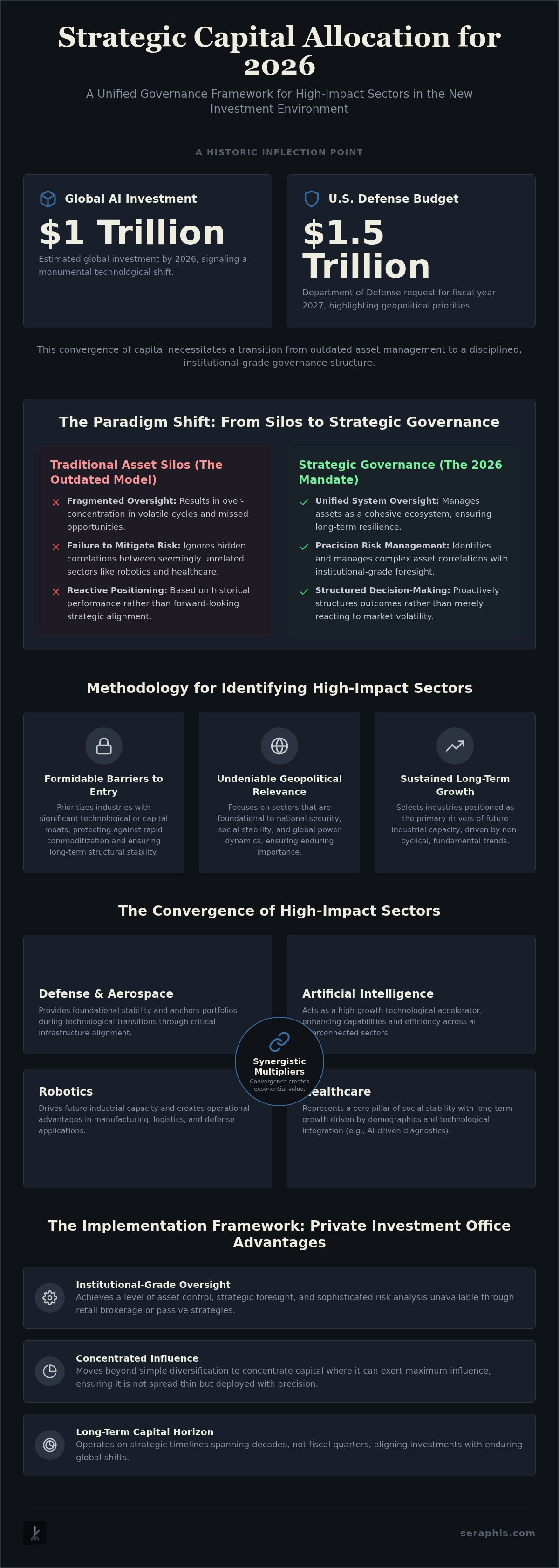
With global AI investment reaching an estimated $1 trillion in 2026 and the U.S. Department of Defense requesting $1.5 trillion for the 2027 fiscal year, the necessity for strategic capital allocation across high-impact sectors has reached a historic inflection point. You've likely recognized that traditional asset silos are increasingly inadequate for managing the convergence of defense, technology, and essential infrastructure. Relying on fragmented oversight often results in over-concentration within volatile cycles or a failure to mitigate the hidden correlations between robotics and healthcare. It's evident that a disciplined, unified approach to governance is now a prerequisite for institutional stability.
This framework, rooted in the principles of a private investment office, introduces a methodical system for aligning capital across defense, AI, and healthcare to ensure long-term resilience. You'll master sophisticated methodologies for capital preservation while identifying critical cross-sector technological synergies. We'll examine how to implement a governance structure that transcends conventional boundaries and manages complex asset correlations with precision. This analysis provides the strategic foresight required to navigate the 2026 investment environment, moving from reactive positioning to a structured, institutional-grade decision-making process.
Key Takeaways
- Understand why the 2026 investment landscape necessitates a transition from traditional asset-class silos toward a model of strategic governance.
- Master the formal criteria for strategic capital allocation across high-impact sectors, focusing on geopolitical relevance and high barriers to entry.
- Identify the synergistic multipliers created when artificial intelligence and robotics converge within the defense and aerospace industries.
- Utilize institutional-grade insights to detect hidden sector vulnerabilities and manage risk correlations in interconnected technology markets.
- Leverage the structural advantages of a private investment office to achieve a level of asset oversight that's unavailable through retail brokerage.
The Evolution of Strategic Capital Allocation in 2026
The year 2026 marks a definitive departure from traditional models of capital distribution. In previous decades, investors often viewed capital allocation as a periodic rebalancing of portfolios based on historical performance. Today, institutional leaders recognize that strategic capital allocation across high-impact sectors requires a more rigorous foundation built on strategic governance. This evolution prioritizes the proactive management of assets as a cohesive system rather than a collection of isolated interests. By moving away from rigid asset-class silos, the private investment office model enables a more fluid integration of thematic sectors that are fundamentally reshaping the global economy.
Institutional gravity demands a focus on long-term capital objectives that remain resilient against short-term market volatility. Unlike retail-led diversification, which often relies on broad indices and passive strategies, institutional-grade strategic advisory utilizes precise, specialized insights to identify value within complex markets. It's an approach that ensures capital isn't merely spread thin but is instead concentrated where it can exert the most influence and achieve the highest level of structural stability. This shift toward methodical precision distinguishes the sophisticated investor from the general market participant.
Foundations of Integrated Capital Management
Modern capital management relies on intellectual rigor to look beyond the surface of historical correlation coefficients. Traditional metrics often fail to capture the underlying technological dependencies that link seemingly unrelated industries. Strategic asset allocation now necessitates a forward-looking alignment that anticipates how advancements in one sector will accelerate growth in another. An integrated framework is a system of governance that treats disparate high-impact sectors as a singular strategic ecosystem. This methodology allows for a more nuanced understanding of how private capital can support and benefit from the convergence of defense, healthcare, and artificial intelligence.
The 2026 Strategic Mandate
The current mandate for strategic capital allocation across high-impact sectors involves identifying industries with low cyclical overlap and formidable technological barriers to entry. Achieving this requires a calculated balance between high-growth ventures in artificial intelligence and the foundational stability provided by critical infrastructure. Such a strategy mitigates risk by ensuring the portfolio remains anchored during periods of technological transition. Institutional strategies are increasingly aligning private capital with global shifts in aerospace and robotics, recognizing these fields as the primary drivers of future industrial capacity. The objective is to build a framework that doesn't just react to change but actively structures it.
Methodology for Identifying High-Impact Investment Sectors
Identifying high-impact sectors in 2026 requires a departure from speculative market sentiment. Instead, a rigorous methodology focuses on three primary pillars: formidable barriers to entry, undeniable geopolitical relevance, and sustained long-term growth potential. This prioritization directs institutional focus toward defense, healthcare, and artificial intelligence. These sectors don't just offer growth; they represent the structural foundations of modern global power and social stability. A methodical approach ensures that capital is deployed where it can achieve the greatest structural impact.
By utilizing institutional-grade insights, professionals can bypass the noise of daily market fluctuations to focus on core fundamentals. This disciplined approach to effective capital allocation ensures that capital is deployed in environments where technological moats protect against rapid commoditization. It's a process of strategic capital allocation across high-impact sectors that values intellectual rigor over momentum. Managing liquidity in these private, high-impact markets also requires a sophisticated understanding of exit horizons, which often span decades rather than fiscal quarters.
Evaluating Defense and Aerospace Resilience
Defense infrastructure serves as a sovereign-backed hedge against broader market volatility. With the 2027 U.S. DoD budget request reaching $1.5 trillion, a nearly 56% increase over the previous year, the scale of commitment to autonomous systems and space-based defense architecture is unprecedented. Aerospace innovation functions as a long-cycle growth engine, providing predictable demand through multi-year procurement contracts. Navigating these complex regulatory environments requires specialized strategic advisory to ensure alignment with national security priorities and sovereign procurement cycles.
Healthcare and Pharmaceuticals: The Stability Pillar
The healthcare and pharmaceutical sectors provide a non-cyclical stability pillar for the institutional portfolio. While technology cycles may fluctuate, the demand for advanced pharmaceuticals and healthcare technology remains constant. Growth opportunities are particularly evident in digital health resilience and biotech, where deep industry knowledge is required to optimize outcomes. By leveraging institutional-grade expertise, investors can identify companies with the technical capacity to solve systemic health challenges. This methodical sector selection ensures that the portfolio remains robust regardless of the broader economic climate. To refine your approach to these complex markets, you may find it useful to review our latest investment insights on sector-specific governance.
Synergistic Allocation: Defense, AI, and Aerospace Convergence
The synergy between artificial intelligence and robotics acts as a definitive force multiplier within the defense sector. While many market participants manage these industries as independent buckets, a more sophisticated approach recognizes that AI's evolution directly accelerates the capabilities of autonomous defense systems. With $20.2 billion allocated for autonomous systems and space-based defense in the 2027 fiscal year budget, the financial impetus for convergence is undeniable. Institutional-grade alpha in 2026 is increasingly found at the intersection of these disparate fields. By managing 'dual-use' technologies through an integrated lens, a private investment office can leverage a single innovation across both aerospace and healthcare applications. Success in strategic capital allocation across high-impact sectors depends on this ability to see beyond traditional industry boundaries.
Case study logic suggests that cross-sector insights drive superior returns in private markets. For instance, advancements in aerospace materials often yield unexpected benefits for defense-grade robotics. This interconnectedness is the hallmark of the 2026 investment landscape. It's no longer enough to be a specialist in one field. One must be a strategist across many. The convergence is real. Synergy drives results. This integrated perspective allows for the identification of value that remains hidden from those using fragmented oversight models.
Technological Convergence as a Strategic Lever
AI investment insights are no longer confined to the technology sector. These insights now inform capital deployment in aerospace and defense, where software-defined hardware is becoming the industry standard. Managing the robotics lifecycle requires an understanding of how a platform might transition from healthcare assistance to industrial defense logistics. Identifying technological overlaps reduces the cost of specialized due diligence. This efficiency allows for a more agile response to emerging opportunities. It's about recognizing that the same neural network architecture driving pharmaceutical research can also optimize satellite constellations.
Critical Infrastructure and Banking Integration
Critical infrastructure provides the physical backbone that supports technological and AI growth. Data centers, energy grids, and specialized manufacturing facilities offer a tangible floor for a multi-sector portfolio. These assets provide stability when high-growth sectors experience cyclical adjustments. Strategic banking investments serve as a vital liquidity and capital management tool, ensuring that the institution maintains the capacity to fund long-cycle projects. Integrating these elements requires a robust academic framework for strategic capital allocation to manage risk and governance effectively. Protecting capital through infrastructure-backed models ensures that the portfolio remains resilient against the volatility often associated with pure-play technology ventures. Institutional frameworks must adapt.
Strategic Governance as a Framework for Risk Mitigation
In a global environment where technologies are increasingly interconnected, risk management must evolve beyond simple portfolio diversification. Traditional approaches often rely on credit ratings or duration management, yet these metrics fail to account for the unique vulnerabilities of private, high-growth assets. Strategic capital allocation across high-impact sectors requires a more robust foundation in strategic governance. This framework serves as a tool for long-term capital preservation, ensuring that institutional objectives remain secure even as technological convergence creates new forms of systemic risk. By implementing methodical, tiered structures, a private investment office can simplify the inherent complexity of multi-sector portfolios without sacrificing specialized oversight.
Institutional-grade insights are essential for identifying hidden sector vulnerabilities that standard market analysis might overlook. Complexity shouldn't invite paralysis. Instead, a structured governance model provides the clarity required to oversee multifaceted private assets without succumbing to information overload. This disciplined approach ensures that every allocation is supported by a clear mandate and a comprehensive understanding of the risk landscape. It's about moving from reactive risk mitigation to a proactive system of institutional resilience.
Advanced Correlation and Contagion Analysis
Modern risk assessment looks far beyond historical data to predict future overlaps in AI and robotics portfolios. In 2026, the primary threat to stability isn't just market volatility but cross-sector contagion. For instance, a regulatory shift in artificial intelligence governance can have immediate, cascading effects on defense procurement and healthcare logistics. Strategic governance acts as a buffer against cross-sector contagion. By anticipating these future correlations, institutional leaders can adjust their positioning before systemic issues manifest. This forward-looking analysis is a core component of strategic capital allocation across high-impact sectors, providing a level of protection that retail models simply can't replicate.
Institutional Compliance and Ethical Standards
Maintaining global standards in pharmaceutical and defense investments is a non-negotiable requirement for principled institutional leadership. These sectors operate under intense regulatory scrutiny, requiring a level of transparency and methodical precision that goes beyond basic compliance. Building a culture of strategic authority involves adhering to rigorous ethical standards that align with long-term institutional values. This commitment to integrity ensures that capital is not only preserved but managed in a way that respects the global significance of these industries. To learn how these principles are applied in practice, you can explore our comprehensive strategic governance framework for private assets.
Implementing Multi-Sector Frameworks via the Private Investment Office
Transitioning from theoretical models to operational excellence requires a structural vehicle designed for precision rather than broad market exposure. Implementing a system of strategic capital allocation across high-impact sectors necessitates a departure from the limitations of traditional brokerage models. While generic advisory often prioritizes volume and standardized products, a private investment office provides the specialized oversight required to manage complex private assets. This institutional framework allows for the seamless integration of defense, AI, and healthcare into a unified strategy. It's a model that prioritizes long-term stability and philosophical alignment over short-term market sentiment.
The move toward operational strategic advisory involves customizing allocation frameworks to meet the specific needs of institutional and private stakeholders. Generic diversification won't suffice in an era defined by rapid technological convergence. Instead, bespoke capital management focuses on the unique requirements of each high-impact field, ensuring that every deployment of capital is supported by deep sector expertise. By moving beyond the asset-class silos discussed earlier, the private investment office creates a more resilient foundation for multi-sector growth. It's a structured approach that transforms complex global insights into actionable capital management protocols.
The Private Investment Office Advantage
The structural advantages of a private investment office are most evident when managing investments in aerospace, robotics, and banking. Unlike generic fund structures that often lack the technical depth to evaluate specialized defense technologies, a private investment office leverages targeted expertise to conduct rigorous due diligence. This bespoke approach ensures that capital isn't merely distributed but is strategically positioned within industries with high technological moats. Accessing global investment strategies through a principled institutional lens allows for a level of asset oversight that retail-adjacent models can't provide. It's about maintaining a clear vision of the global landscape while executing with methodical precision.
Engaging Strategic Advisory for Multi-Sector Growth
Evaluating an advisory partner’s depth in the defense and healthcare sectors is a critical step in the implementation process. A sophisticated partner must demonstrate more than just market awareness. They must possess a fundamental understanding of the regulatory and technological drivers within these specialized fields. Philosophical alignment remains the primary differentiator in successful capital management, as it ensures that the advisory team and stakeholders share a commitment to long-term institutional resilience. Identifying a partner with the capacity to provide strategic capital allocation across high-impact sectors is essential for navigating the 2026 landscape. For those prepared to implement these frameworks, you can Contact Seraphis Group for institutional-grade investment insights and specialized advisory services.
Securing Institutional Resilience in a Connected Global Economy
The 2026 investment landscape demands a transition from traditional asset-class silos to a more integrated, thematic approach. Institutional resilience is no longer a matter of simple diversification; it's a result of rigorous strategic governance. By recognizing the synergies between defense, artificial intelligence, and aerospace, you can secure a portfolio against the hidden correlations of modern technological cycles. This methodology for strategic capital allocation across high-impact sectors ensures that private capital isn't merely distributed but actively managed through a principled institutional framework.
Seraphis Group provides the specialized expertise in defense, AI, and robotics necessary to navigate these complex markets with confidence. Our commitment to global investment strategy and institutional-grade governance offers a stable alternative to the fragmented oversight found in generic advisory models. As you refine your long-term objectives, a methodical partnership is the most effective path toward capital preservation and growth. It's time to move beyond theoretical frameworks and implement a structure that reflects the global sophistication of your goals.
Explore Strategic Capital Management at Seraphis Group to align your assets with the strategic mandates of the coming decade. We look forward to supporting your institutional vision.
Frequently Asked Questions
What is strategic capital allocation in high-impact sectors?
Strategic capital allocation in high-impact sectors is a methodical system for distributing capital into industries with high barriers to entry and significant geopolitical importance. It treats these sectors as a singular strategic ecosystem rather than isolated buckets. By focusing on areas like AI and defense, this approach prioritizes long-term institutional resilience over short-term market cycles. It's about ensuring every dollar supports a broader vision of stability and growth while maintaining rigorous governance standards.
How does a private investment office differ from a retail brokerage in capital management?
A private investment office provides specialized, bespoke advisory and governance that isn't available through retail brokerage services. While retail models often rely on standardized products and broad diversification, an office like Seraphis Group focuses on private assets and specialized sectors. This structure allows for deeper due diligence and a more sophisticated alignment with long-term capital objectives. It's a model that explicitly avoids the mass-market approach and personal financial planning typical of retail firms.
Why is defense considered a high-impact sector for institutional capital in 2026?
Defense is a critical sector due to its sovereign-backed stability and the massive increase in government procurement budgets. With the U.S. DoD budget request reaching $1.5 trillion for fiscal year 2027, the scale of investment in autonomous systems is unprecedented. This sector provides a reliable hedge against market volatility. It offers long-cycle growth that's fundamentally decoupled from the fluctuations of the consumer retail economy, making it a cornerstone for institutional-grade portfolios.
How do integrated frameworks manage risk correlation between AI and robotics?
Integrated frameworks identify the underlying technological dependencies that link artificial intelligence and robotics systems. By treating these fields as a singular ecosystem, investors can better predict how a regulatory shift in one area might affect the other. This proactive approach to strategic capital allocation across high-impact sectors reduces the risk of systemic contagion. It allows for a more nuanced understanding of asset vulnerabilities across a multi-sector portfolio without relying on historical data alone.
What role does strategic governance play in private equity investments?
Strategic governance acts as the primary differentiator for multi-sector success in private equity. It provides a formal structure for decision-making, ensuring that every investment aligns with established ethical and institutional standards. This framework manages the complexity of private assets by implementing tiered oversight and clear mandates. Governance is the essential tool for preserving capital and ensuring long-term philosophical alignment within a high-impact portfolio, moving beyond the surface-level metrics used by traditional advisors.
Can multi-sector frameworks be applied to global infrastructure projects?
Multi-sector frameworks provide the physical backbone necessary for technological and industrial growth in global infrastructure. Infrastructure projects, such as data centers and specialized energy grids, offer a tangible floor that stabilizes a portfolio focused on high-growth sectors. These frameworks ensure that infrastructure assets are managed with the same institutional rigor as defense or AI investments. This integration supports the broader objective of maintaining liquidity and structural resilience across a worldwide investment scope.
Why is 2026 a critical year for aerospace and healthcare investment strategy?
The year 2026 marks a historic inflection point where technological convergence in aerospace and healthcare has reached industrial scale. Advancements in robotics and AI are now driving significant non-cyclical value in biotech and satellite architecture. Investors must adapt their strategies to account for these shifts before traditional market models become obsolete. It's a pivotal moment for establishing the governance structures required to manage these high-barrier industries effectively and ensuring long-term capital stability.
How does Seraphis Group provide strategic advisory for multi-sector capital?
Seraphis Group offers specialized investment insights and bespoke capital management through a private investment office model. The firm leverages deep expertise in defense, AI, and healthcare to optimize outcomes for institutional partners. By focusing on strategic capital allocation across high-impact sectors, the group ensures that every decision is backed by intellectual rigor and global strategy. This methodical approach prioritizes strategic governance and long-term capital preservation over passive market participation or generic fund structures.


