

The distinction between mere market data and genuine institutional grade investment insights is often found in the rigor of the underlying governance framework rather than the volume of information available. In an era where retail-focused media frequently obscures strategic clarity with superficial analysis, the ability to isolate high-impact signals in specialized sectors like defense and AI remains a rare institutional capability. You likely recognize the frustration of navigating a landscape where the sheer velocity of data fails to translate into long-term strategic value. This article outlines the precise methodology and strategic governance required to transform raw market inputs into sophisticated intelligence for 2026.
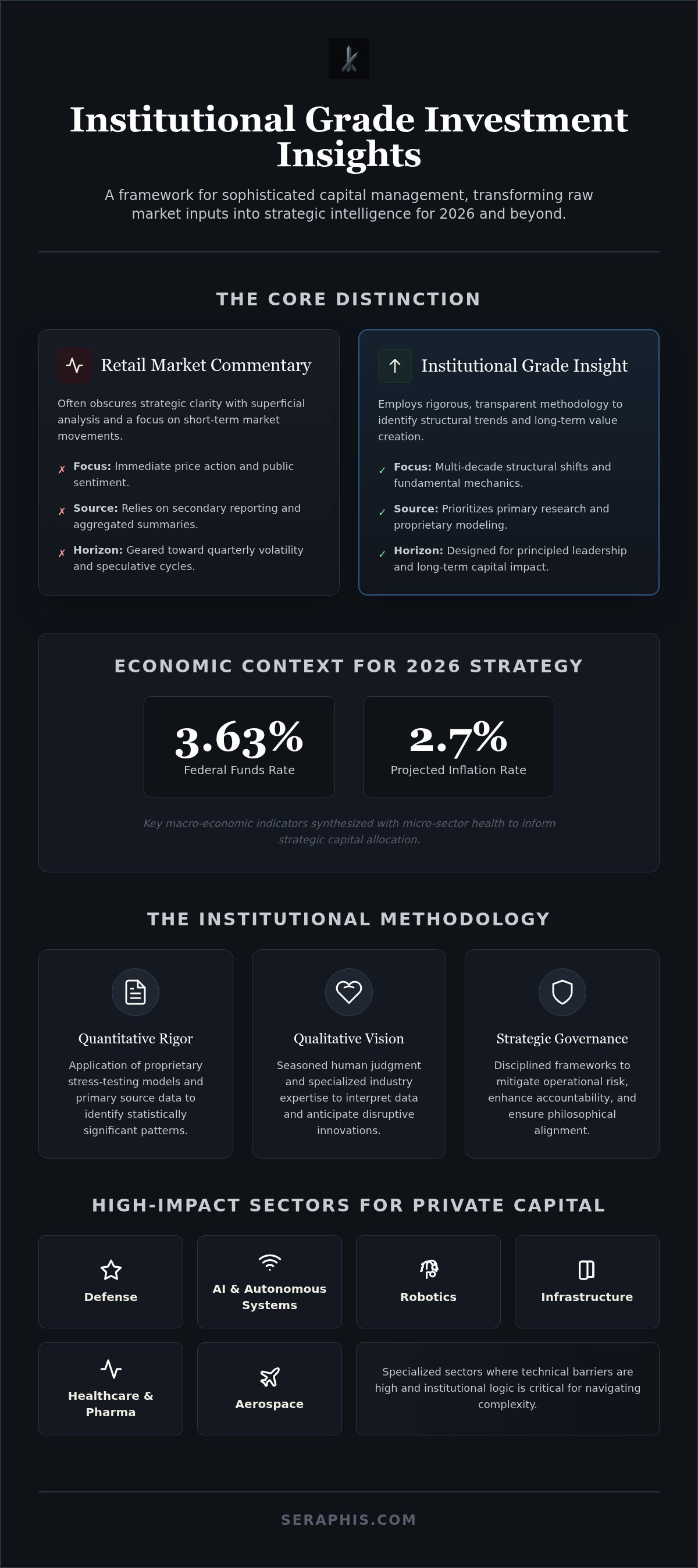
By establishing a clear framework for evaluating opportunities in robotics and aerospace, we'll demonstrate how systematic capital management operates beyond the reach of conventional market noise. We'll examine the role of strategic governance in an economic environment characterized by a 3.63% federal funds rate and a projected 2.7% inflation rate. You'll gain a comprehensive understanding of the sectors poised for structural growth and the analytical discipline necessary to manage private capital with institutional precision. This overview provides the foundational principles for identifying value in a broadening market where leadership extends beyond a high concentration in technology stocks.
Key Takeaways
- Understand the structural differences between retail commentary and institutional grade investment insights, focusing on the rigorous methodologies that ensure data integrity.
- Learn how a Global Investment Strategy integrates quantitative modeling with specialized industry expertise to identify long-term value in defense and aerospace sectors.
- Discover how strategic governance frameworks mitigate operational risks and enhance accountability within complex healthcare and pharmaceutical investments.
- Identify the specific advantages of managing private capital through a private investment office to achieve philosophical alignment and methodical precision.
- Explore why artificial intelligence and autonomous systems require a specialized institutional approach to navigate the broadening market leadership projected for 2026.
Defining the Parameters of Institutional Grade Investment Insights
Institutional grade investment insights represent a fundamental departure from the speculative nature of retail market commentary. While public financial news often focuses on immediate price action or sentiment, institutional standards demand a focus on the structural mechanics of long-term value creation. This distinction is rooted in the depth of analysis and the transparency of the methodology employed. It isn't merely about having access to more data; it's about the systematic processing of that information through a lens of strategic governance and intellectual rigor.
Beyond Market Commentary: The Standard of Rigor
The level of rigor required for these insights necessitates a reliance on primary source data and proprietary modeling. Unlike retail analysis, which may rely on secondary reporting or aggregated summaries, an institutional investor prioritizes direct access to industry leaders and technical specialists. This approach allows for the identification of structural trends that persist beyond cyclical market noise. Objective, transparent reporting ensures that every conclusion is traceable to a specific, verifiable data point, providing a level of clarity that stabilizes the decision-making process.
- Primary Research: Prioritization of original data over aggregated secondary sources to ensure accuracy.
- Proprietary Modeling: Application of customized stress-testing models specifically for specialized sectors like defense and AI.
- Structural Focus: Emphasis on multi-decade shifts rather than quarterly volatility or speculative cycles.
The Role of Information Symmetry in Private Markets
Sophisticated capital management strives for information symmetry, which is the state where all relevant parties possess a comprehensive understanding of the risk and opportunity landscape. In private capital markets, this symmetry is often achieved through specialized research into sectors like defense and aerospace, where technical barriers are high and public disclosure is limited. A private investment office bridges the gap between raw technical innovation and strategic capital allocation, ensuring that investors aren't operating at a disadvantage compared to market insiders.
Maintaining this symmetry involves ethical considerations and a commitment to high-level strategic advisory. It's not just about identifying profit; it's about the duty to manage capital with methodical precision and philosophical alignment. By focusing on long-term outcomes rather than short-term volatility, institutional grade investment insights provide the stability needed for principled leadership. This disciplined framework ensures that capital is deployed where it can achieve the most significant impact while adhering to established governance standards.
The Methodology Behind Sophisticated Capital Management
Sophisticated capital management relies on a tiered validation process that filters raw data through both mathematical models and seasoned human judgment. This dual approach ensures that institutional grade investment insights aren't just statistically significant but also strategically viable. A successful Global Investment Strategy requires more than a passive observation of market movements; it demands an active synthesis of macro-economic indicators, such as the current 3.63% federal funds rate, with the micro-sector health of specialized industries like infrastructure and aerospace. Before any capital allocation occurs, every insight undergoes a rigorous vetting process to confirm that the underlying logic holds across multiple economic scenarios.
Quantitative Rigor vs. Qualitative Vision
Data provides the foundation, but it's often insufficient without the strategic guidance of industry experts. In specialized sectors like pharmaceuticals and robotics, historical performance metrics rarely capture the disruptive potential of upcoming technical milestones. While quantitative analysis identifies patterns, qualitative vision interprets how shifting regulatory environments or breakthrough innovations will alter those patterns. Research, such as this NBER working paper on investor skill, suggests that the ability to generate alpha in private markets is closely tied to the specific expertise and operational involvement of the investment team. Balancing these two disciplines involves a methodical validation process:
- Back-testing Models: Evaluating how quantitative frameworks would have performed under previous periods of high volatility.
- Sector Expert Review: Subjecting data-driven conclusions to the scrutiny of veterans in aerospace and healthcare.
- Scenario Mapping: Developing multiple future states based on projected innovation trends rather than just historical averages.
Synthesis of Global Macro Trends in 2026
The economic environment of 2026 is defined by a broadening of market leadership beyond traditional technology stocks. Large-scale global infrastructure projects act as significant anchors for private capital, providing stability even as banking sector dynamics fluctuate. While the Federal Reserve manages inflation targets near 2.7%, the liquidity provided by the banking sector remains a critical variable for capital deployment. Aerospace technology has emerged as a primary macro-economic driver, influencing everything from global logistics to national security frameworks. Understanding these intersections is vital for any Global Investment Strategy that seeks to preserve and grow capital in a complex global market. By integrating these macro trends with precise sector analysis, institutional leaders can move beyond reactive decision-making to a position of stability.
Applying Institutional Logic to High-Impact Sectors: Defense and AI
High-impact sectors require a level of analytical depth that transcends standard market observations. Applying institutional grade investment insights to defense and artificial intelligence involves understanding how these fields interact with sovereign interests and global infrastructure. While retail investors often focus on the immediate news cycle, institutional frameworks prioritize the long-term structural role these technologies play in national security and economic stability. The transition toward private capital participation in highly regulated industries marks a significant shift in how strategic capital allocation is executed in the 2026 landscape.
Defense Sector Strategic Capital Allocation
The defense sector serves as a primary driver of technological innovation, often incubating advancements that eventually transition into the civilian market. Institutional analysis identifies these 'dual-use' technologies, such as advanced aerospace materials or encrypted communication protocols, which offer value beyond their initial military applications. Because national security interests provide a baseline of demand, the sector offers a unique risk-return profile compared to more cyclical industries. This OECD analysis on institutional investor engagement emphasizes the growing importance of governance in sectors with high public-private overlap. Effective capital management in this arena requires deep technical expertise to distinguish between transient procurement cycles and the enduring technological shifts that define the current era.
Navigating the Robotics and AI Frontier
Institutional-grade AI assets are defined by their integration into critical operations rather than speculative consumer hype. With 65% of institutional investors predicting that artificial intelligence will supercharge growth by late 2026, the focus has shifted toward machine learning systems that enhance global supply chain resilience. Robotics provides a tangible solution to logistical bottlenecks in infrastructure, yet these assets require expert strategic guidance to navigate the evolving regulatory landscape. This approach ensures that capital is deployed into autonomous systems that possess a clear path to commercial viability and operational stability, moving beyond the volatility of speculative news.
Comparing critical infrastructure to the robotics industry reveals a spectrum of risk that demands precise calibration. Infrastructure offers predictable yields, while robotics and AI present higher growth potential coupled with technical volatility. Managing this balance requires a disciplined approach to institutional grade investment insights that accounts for both the maturity of the technology and the stability of the regulatory environment. By applying rigorous logic, a private investment office can secure a position in these high-impact sectors that is both principled and strategically sound, ensuring that long-term objectives remain the primary focus.
Strategic Governance as a Catalyst for Long-Term Returns
Strategic governance serves as the operational architecture that ensures accountability and disciplined decision-making across all capital allocations. It's not a passive compliance metric; it's a dynamic framework that translates institutional grade investment insights into sustained, long-term performance. By establishing clear parameters for responsibility and transparency, governance provides the stability required to manage complex assets in sectors with high regulatory barriers. This methodical approach ensures that every decision aligns with the foundational principles of the investment office, creating a predictable environment for growth even amidst broader market uncertainty.
In sectors like healthcare and pharmaceuticals, governance acts as a critical risk mitigation tool. It provides the necessary oversight to navigate the intricate lifecycles of clinical trials and the shifting landscapes of global regulatory approvals. By ensuring that capital deployment follows a principled, tiered validation process, governance protects the portfolio from the binary risks often associated with medical innovation. This disciplined oversight is what separates institutional standards from speculative, news-driven entries, ensuring that private equity returns are driven by structural health rather than market sentiment.
Managing Cross-Sector Correlation
Institutional governance is essential for managing the growing correlation between sectors like artificial intelligence and banking. As financial institutions increasingly integrate autonomous systems into their core operations, the risk profiles of these two industries become inextricably linked. A methodical cross-sector risk assessment identifies these hidden dependencies, allowing for a more resilient portfolio construction. This process involves several key components:
- Structural Overlap Analysis: Identifying where technical failures in machine learning could trigger liquidity issues within banking frameworks.
- Unified Reporting Standards: Ensuring that data from disparate sectors is processed through a single, transparent governance lens to maintain information symmetry.
- Strategic Capital Buffers: Maintaining the flexibility to rebalance holdings when correlations between technology and infrastructure exceed established thresholds.
Ethical Standards and Infrastructure Resilience
Ethical capital management isn't merely a philosophical preference; it's a prerequisite for infrastructure resilience and long-term asset value. Large-scale projects, particularly in transport or energy, require governance models that ensure strict alignment with global regulatory standards. Research indicates that 58% of institutions are now incorporating ESG frameworks specifically for their alpha potential and risk control, confirming that ethical standards are a primary driver of financial performance. Strategic advisory services provide the oversight necessary to maintain this alignment across multi-decade lifecycles, ensuring that institutional grade investment insights remain rooted in principled leadership. To implement these frameworks within your own capital management strategy, explore the Strategic Governance solutions provided by our private investment office.
Integrating Institutional Insights into a Private Investment Office
The integration of institutional grade investment insights into a private investment office represents a significant elevation in the management of private capital. Unlike traditional brokerage models that often prioritize high-volume execution and retail-style sentiment, a private investment office operates with the gravity and methodical precision of a global strategist. This structure allows for the delivery of bespoke investment insights that are filtered through the rigorous methodologies and stress-testing protocols discussed previously. By focusing on long-term structural health rather than immediate market fluctuations, the private office provides a stable environment for capital preservation and growth in specialized sectors.
Transitioning from a retail-style mindset to an institutional strategy involves a fundamental shift in how data is interpreted. While many standard models focus on broad market indices, institutional grade investment insights prioritize the technical and regulatory nuances of high-growth industries. This transition ensures that capital is not merely participating in the market but is instead being deployed with a specific, governed intent. It's a move away from reactive decision-making toward a proactive, principled approach that values information symmetry and intellectual rigor.
From Retail Thinking to Strategic Advisory
Specialized capital management differs significantly from standard financial planning in both scope and depth. While personal planning often addresses general wealth goals, specialized management applies institutional logic to complex fields such as robotics and aerospace. This level of advisory requires a deep understanding of the technical barriers and sovereign interests that define these industries. Seraphis Group provides the strategic guidance necessary to navigate these complexities, ensuring that every allocation is supported by primary research and proprietary modeling. By moving beyond the limitations of retail-focused analysis, investors can access a level of strategic clarity that is typically reserved for large-scale institutional entities.
The Seraphis Group Perspective for 2026
As we look toward 2026, our focus remains on the critical intersections of defense, healthcare, and advanced technology. The broadening of market leadership suggests that success will depend on the ability to identify value in infrastructure and autonomous systems that support global resilience. Strategic governance will continue to be the primary catalyst for long-term returns, providing the framework for accountability and ethical capital management. We invite you to consider how these institutional frameworks can be integrated into your own capital strategy to achieve philosophical alignment and operational stability.
To explore the role of strategic governance and specialized insights in your capital management process, the next step involves a formal review of your current framework. Engaging with a private investment office allows for a tailored implementation of the Global Investment Strategy principles outlined in this article. By adopting an institutional standard, you ensure that your capital is managed with the methodical precision required for the complex economic landscape of 2026.
Advancing Capital Management Through Methodical Precision
The transition toward sophisticated capital management requires a departure from reactive market sentiment in favor of established institutional standards. Precision defines the standard. The synthesis of primary data and strategic governance creates a framework capable of identifying value within specialized sectors. By prioritizing information symmetry and rigorous methodology, private capital achieves the stability necessary to navigate a landscape defined by broadening market leadership and shifting regulatory requirements. These institutional grade investment insights provide the clarity required to manage multi-decade assets with principled precision.
Seraphis Group offers specialized expertise in defense and AI sectors, applying an institutional-grade methodology to the unique needs of private capital. Our approach provides global strategic advisory for critical infrastructure, ensuring that every allocation is supported by technical rigor and philosophical alignment. We invite you to Explore Strategic Governance Frameworks with Seraphis Group to enhance your organization's decision-making architecture. Adopting a methodical, long-term perspective ensures that your capital remains resilient and well-positioned for the opportunities of 2026.
Frequently Asked Questions
What makes an investment insight 'institutional grade'?
An insight is considered institutional grade when it's derived from a rigorous methodology that prioritizes primary source data and proprietary modeling over superficial market commentary. These institutional grade investment insights are characterized by transparency and a focus on structural trends rather than cyclical volatility. By applying this level of intellectual rigor, investors can isolate high-impact signals within complex sectors, ensuring that capital deployment is supported by verifiable data points.
How does a private investment office differ from a retail brokerage?
A private investment office focuses on bespoke capital management and strategic guidance for specialized sectors, whereas a retail brokerage typically prioritizes high-volume execution and standardized financial products. Seraphis Group explicitly avoids retail brokerage services and personal financial planning. Instead, the firm operates as a global strategist, providing institutional grade investment insights that align with the philosophical objectives of sophisticated investors, ensuring a high degree of stability and methodical precision.
Why is strategic governance important for AI and robotics investments?
Strategic governance provides the architectural framework necessary for accountability and disciplined decision-making within technical fields like AI and robotics. Because these sectors face rapid innovation and evolving regulatory standards, a clear governance structure helps mitigate operational risks. It ensures that investments in autonomous systems or machine learning are integrated into broader infrastructure with a focus on supply chain resilience and ethical standards, rather than following transient speculative trends.
Can institutional insights be applied to the defense and aerospace sectors?
Institutional insights are essential for navigating the defense and aerospace sectors due to their high technical barriers and reliance on sovereign procurement cycles. These insights allow for the identification of dual-use technologies that possess significant value in both military and civilian applications. By analyzing national security interests and technical innovation through a disciplined institutional lens, investors can secure positions in aerospace materials and encrypted communications that offer long-term structural growth.
What are the high-impact investment sectors for 2026?
The high-impact sectors for 2026 include defense technology, artificial intelligence, robotics, and critical infrastructure. These industries are projected to drive global economic resilience as market leadership broadens beyond a high concentration in technology stocks. Institutional sentiment suggests that 65% of investors expect AI to supercharge growth by late 2026. Additionally, specialized sectors like pharmaceuticals and aerospace are prioritized for their ability to offer stable returns within a structured governance framework.
How do institutional investors manage risk in pharmaceutical investments?
Institutional investors manage risk in pharmaceuticals by implementing a tiered validation process that oversees the entire clinical trial and regulatory approval lifecycle. This approach protects the portfolio from the binary risks inherent in medical innovation by ensuring that every pharmaceutical investment follows a disciplined governance model. By prioritizing structural health and regulatory alignment, investors can navigate the complexities of healthcare without relying on the speculative volatility often found in retail-focused reports.
What is the role of strategic advisory in global infrastructure projects?
Strategic advisory ensures that large-scale infrastructure projects remain aligned with global regulatory standards and multi-decade resilience goals. Advisory services provide the oversight necessary to manage the ethical and operational complexities of transport or energy projects. This involves coordinating with institutional partners to establish strategic capital buffers and unified reporting standards. Such oversight is critical for maintaining asset value and ensuring that infrastructure investments contribute to the long-term stability of the global economy.
How does Seraphis Group approach specialized capital management?
Seraphis Group approaches specialized capital management through a Global Investment Strategy that integrates quantitative modeling with deep sector-specific expertise. The firm focuses on high-impact industries like defense, healthcare, and robotics while maintaining a composed, strategic authority. By emphasizing strategic governance and philosophical alignment, the group ensures that capital is managed with methodical precision. This approach excludes retail brokerage or personal financial planning, focusing instead on delivering sophisticated insights for complex private assets.


