

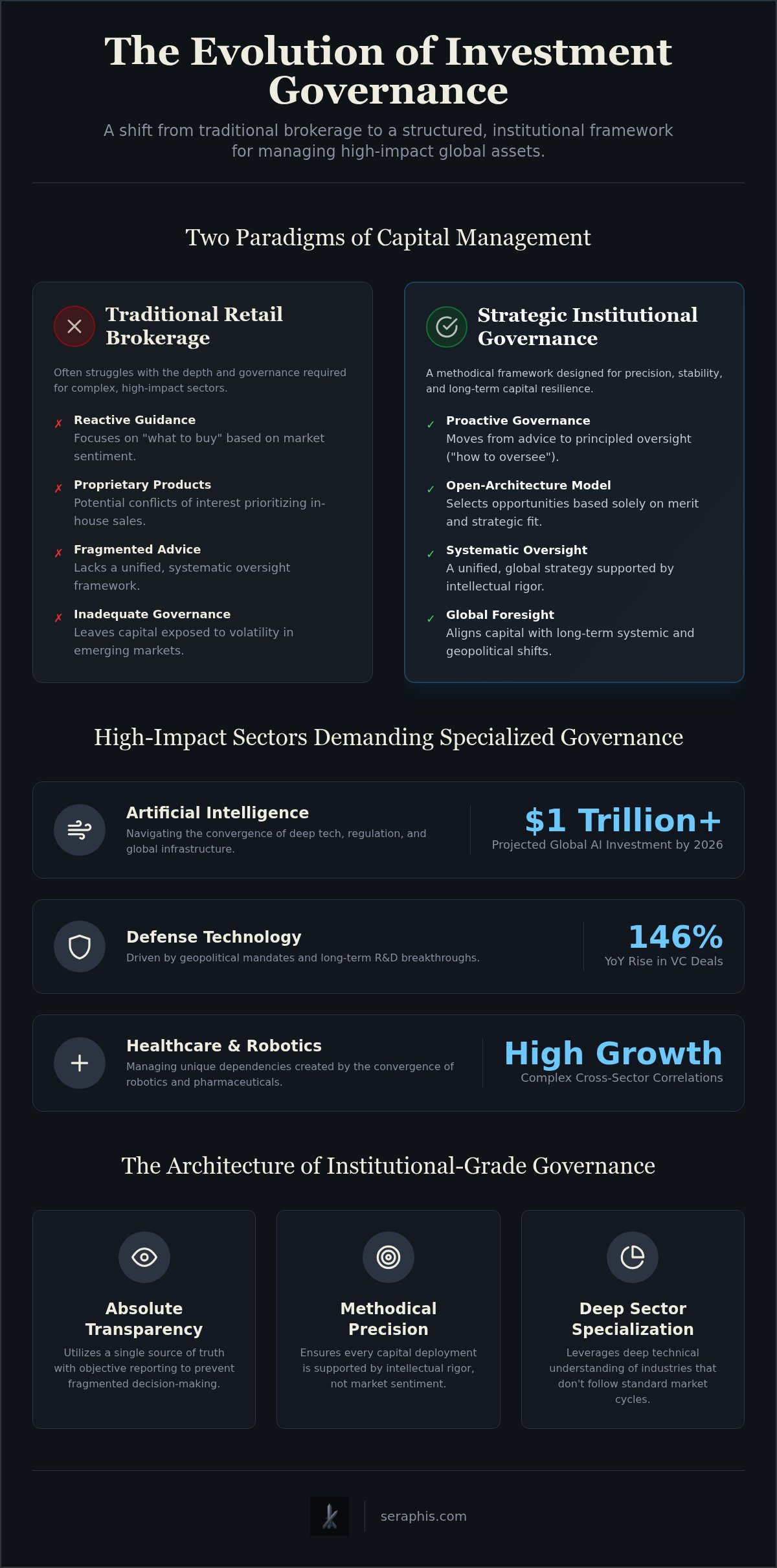
With global AI investment projected to exceed $1 trillion in 2026 and venture capital deals in defense technology rising by 146% year-over-year, the traditional boundaries of capital allocation are being redrawn. Many institutional stakeholders recognize that standard retail brokerage often lacks the necessary depth to manage these high-impact sectors with the required precision. You've likely observed that fragmented advice and inadequate governance frameworks for private equity can leave capital exposed to volatility in emerging markets.
This executive analysis provides a comprehensive look at how a dedicated strategic investment advisory model utilizes institutional frameworks to bridge these systemic gaps. We'll explore the synthesis of sector-specific governance and global foresight necessary to secure capital management that aligns with long-term trends. By the end of this briefing, you'll understand how specialized investment offices navigate the complexities of defense, artificial intelligence, and healthcare through a structured, principled approach. This transition from broad market participation to methodical, strategic governance ensures that your portfolio remains resilient against the shifting regulatory and geopolitical realities of the coming year.
Key Takeaways
- Understand the evolution of strategic investment advisory as a high-level governance framework that transcends traditional asset management.
- Master the architecture of institutional governance to ensure systematic oversight of private equity and emerging market portfolios.
- Analyze the strategic intersection of defense technology, artificial intelligence, and healthcare to align capital with long-term global trends.
- Utilize a specialized 5-point assessment framework to identify investment partners capable of delivering institutional-grade sector precision.
The Evolution of Strategic Investment Advisory in 2026
The term strategic investment advisory represents more than a service category; it's a formal governance framework designed for the complexities of the current fiscal year. In 2026, the distinction between simple asset allocation and institutional-grade guidance has become absolute. We've moved past the era where passive management sufficed for wealth preservation. Today, the volatility of high-impact sectors requires a methodical, active approach. This framework prioritizes the systematic oversight of capital through three core pillars: absolute transparency, methodical precision, and deep sector specialization. It's a shift from the reactive nature of the past toward a proactive, strategic stance.
Defining the 2026 Advisory Landscape
Global volatility has necessitated a move toward institutional-grade insights that traditional models can't provide. As regulatory thresholds for qualified clients have increased, the need for sophisticated risk mitigation has grown proportionally. Strategic governance plays a vital role in identifying and managing cross-sector correlation risks. For example, the convergence of robotics and healthcare creates unique dependencies that standard portfolios often overlook. A long-term strategic partnership focuses on these intersections. It relies on established investment strategy principles to ensure that every capital deployment is supported by intellectual rigor rather than market sentiment. This approach transforms the advisory relationship from a series of transactions into a unified, principled mandate.
Institutional Logic vs. Retail Brokerage
Specialized capital management requires a private office structure to maintain the necessary depth of analysis. Retail brokerage services often prioritize proprietary product sales, which can create friction between the advisor's incentives and the client's objectives. An institutional framework avoids these conflicts by utilizing an open-architecture model. This ensures that the selection of opportunities in sectors like defense or infrastructure is based solely on merit and strategic fit. It's about stability. The 2026 landscape demands a partner who operates as a global strategist, looking at the macro picture while maintaining micro-level precision in execution. Strategic investment advisory is the synthesis of rigorous institutional governance and forward-looking global foresight. By removing the distractions of retail-grade products, a private investment office can focus on the long-term trajectory of global trends.
- Governance over Guidance: Moving from "what to buy" to "how to oversee."
- Sector Depth: Utilizing deep expertise in AI, aerospace, and pharmaceuticals.
- Global Reach: Accessing institutional-grade insights across international markets.
The transition to this model isn't just a preference; it's a requirement for those managing significant capital in a fragmented world. It ensures that capital isn't just deployed, but is governed with a sense of duty and precision. This structured path provides the clarity needed to navigate the emerging regulatory shifts and technological disruptions of the coming years.
The Architecture of Institutional-Grade Governance
Institutional governance serves as the structural foundation of a private investment office. It represents a deliberate departure from the individualized planning common in retail sectors. Instead, it utilizes a Global Investment Strategy that prioritizes the alignment of capital with systemic shifts and geopolitical realities. This framework ensures that every decision is supported by intellectual rigor and transparent reporting standards. Methodical precision isn't just a preference; it's the mechanism that provides stability in a fragmented global economy. By adopting a high-level strategic register, elite offices move beyond reactive trading toward principled capital management. Strategic investment advisory becomes the lens through which all opportunities are filtered, ensuring philosophical alignment with the client's long-term objectives.
Foundational Principles of Private Offices
Allocation in 2026 requires deep technical understanding, particularly in high-impact sectors like aerospace and robotics. These industries don't follow standard market cycles. They're driven by geopolitical mandates and long-term research breakthroughs. Objective, transparent reporting is essential in these contexts. A multi-sector portfolio requires a single source of truth to prevent fragmented decision-making across disparate assets. In banking, navigating the 2026 financial infrastructure involves understanding the integration of digital liquidity and institutional stability. This level of strategic governance ensures that capital remains robust against systemic shocks while maintaining access to global markets.
Risk Mitigation through Strategic Oversight
Identifying "black swan" events is a core function of institutional oversight. In critical infrastructure projects, risks often reside in subtle regulatory shifts or complex supply chain vulnerabilities. As the SEC and FINRA have prioritized AI governance as a key examination priority for 2026, institutional compliance must be integrated into the investment process for machine learning. Strategic investment advisory provides the oversight needed to ensure these technologies are governed ethically and within strict regulatory bounds. Deep industry knowledge allows for the anticipation of market shifts before they manifest in public data. This foresight separates institutional-grade capital management from standard retail models. It's about maintaining a composed, strategic authority over the portfolio, ensuring that every move is deliberate and carefully considered within the broader global context.
Sector-Specific Advisory: Defense, AI, and Healthcare
Effective capital management in 2026 requires more than generalist oversight. It demands a specialized strategic investment advisory approach that synthesizes technical sector knowledge with institutional governance. High-impact industries like defense, artificial intelligence, and pharmaceuticals are increasingly driven by geopolitical mandates and rapid technological breakthroughs rather than traditional market cycles. Understanding these drivers is essential for maintaining portfolio stability and identifying genuine growth opportunities. Generic market access often fails to account for the specific regulatory and operational risks inherent in these specialized sectors.
Defense and Aerospace: Strategic Capital Allocation
The defense sector has seen a marked resurgence in both government spending and private investment. The U.S. Department of Defense budget request for 2026 reached $961.6 billion, a 13% increase over the previous year. This surge is mirrored in private markets, where venture capital deals in defense technology reached a record $19.8 billion in the first quarter of 2026. This represents a 146% year-over-year increase, highlighting the urgency behind aerospace and robotics innovation. Navigating this landscape requires a deep understanding of defense infrastructure and the strategic governance of autonomous systems. It's not just about capital deployment; it's about aligning with global defense policies that dictate long-term infrastructure projects and technological adoption.
Healthcare and Pharmaceuticals: Managing Innovation
The biopharma sector continues to attract significant institutional capital, raising $12.6 billion in venture funding during the first half of 2026. This investment is increasingly focused on technology-driven healthcare and outpatient care models. Specialized advisory frameworks help manage the inherent risks of pharmaceutical innovation while capitalizing on the shift toward ambulatory surgery centers and medical office buildings. Digital resilience has also become a critical priority. As healthcare systems integrate AI-enabled diagnostics and complex data networks, strategic oversight ensures that these assets are protected and compliant with emerging standards. This methodical approach leads to more predictable outcomes in a sector defined by regulatory complexity and long development timelines.
- AI Governance: Managing the projected $1 trillion global AI investment through rigorous institutional compliance and ethical standards.
- Infrastructure Precision: Optimizing critical infrastructure projects by identifying technical risks and supply chain vulnerabilities before they manifest.
- Technical Depth: Utilizing sector-specific expertise in robotics and pharmaceuticals to drive growth that aligns with global trends.
By focusing on these high-impact sectors, a private investment office provides the depth of insight that standard retail models lack. It ensures that capital isn't just allocated, but is governed with a clear understanding of the technical and global trends shaping the future. This structured path provides the clarity needed to navigate the emerging regulatory shifts and technological disruptions that define the modern investment landscape.
Evaluating Strategic Partners: A Framework for Private Offices
Selecting a partner to manage institutional-grade capital requires a fundamental shift from performance-based metrics toward governance-based evaluation. For stakeholders navigating the 2026 fiscal environment, the primary objective is to identify an entity that functions as a principled extension of the private office. This selection process must be rigorous and objective. It should prioritize a partner's ability to provide a comprehensive strategic investment advisory framework over simple transactional execution. A composed, strategic authority is required to oversee assets in sectors where the margin for error is minimal.
The 5-Point Evaluation Checklist
A robust evaluation begins with a technical audit of the advisor's capabilities. Generalist advice is insufficient for the high-impact sectors that define modern portfolios. Institutional stakeholders should utilize the following criteria during their assessment:
- Technical Depth: Verify whether the advisor possesses genuine expertise in defense innovation, aerospace, and artificial intelligence.
- Governance Maturity: Ensure there is a documented framework for the systematic oversight of private equity and emerging technologies.
- Conflict Neutrality: Confirm the firm is strictly institutional, maintaining a clear separation from retail brokerage and proprietary products.
- Global Strategic Reach: Assess whether the partner has the infrastructure to monitor and act on cross-sector global trends.
- Philosophical Alignment: Determine if the advisor's institutional philosophy mirrors the long-term mission and ethical standards of the private office.
Transparency remains the cornerstone of this relationship. The presence of retail products often introduces misaligned incentives. These conflicts compromise the integrity of the advice provided to sophisticated capital managers. A specialized partner operates with an open-architecture model. This ensures every recommendation is based on methodical research and strategic fit rather than commission-based targets.
Identifying Institutional Alignment
Alignment is often revealed through the quality of executive-level briefings. These sessions don't merely present data. They provide clarity on how global shifts affect the overarching strategy. Stability is another critical indicator of institutional gravity. A firm that maintains a methodical, patient pace demonstrates the composure required to manage long-term assets. Infrastructure and banking require a decade-level perspective. Retail-focused firms often struggle to maintain this outlook, as their structures are designed for high-volume, short-term activity. Identifying a partner who values governance and philosophical alignment is essential for capital preservation. For those seeking this level of structured oversight, exploring a strategic investment advisory partnership provides the necessary framework for long-term success.
The Seraphis Model: Integrating Global Vision with Sector Precision
The Seraphis Group approach is defined by a commitment to institutional gravity and the absolute avoidance of retail-grade conflicts. We recognize that managing institutional capital in 2026 requires a high degree of technical sophistication, particularly when addressing the convergence of AI and defense infrastructure. Our model is built on the foundation of strategic investment advisory, ensuring that every decision is filtered through a rigorous governance framework. This isn't a casual partnership; it's a principled mandate designed for stakeholders who value stability, clarity, and global foresight. By maintaining a composed, strategic authority, we provide the intellectual rigor necessary to oversee high-impact sectors with methodical precision.
A Principled Approach to Global Strategy
Implementation of our Global Investment Strategy follows a tiered, logical sequence. We move from foundational principles to operational applications, focusing on the sectors that drive modern infrastructure. Whether analyzing the strategic governance of pharmaceuticals or the complexities of aerospace robotics, our methodology remains steady and organized. This patient pace reinforces our role as a stable entity that doesn't make rushed decisions based on market sentiment. We identify the structural shifts that define the 2026 landscape, ensuring that your portfolio remains resilient against geopolitical instability. Our framework prioritizes the following core elements:
- Sector Precision: Utilizing deep technical expertise in Defense Investments, AI, and Healthcare to drive growth.
- Institutional Gravity: Applying a formal, objective approach to capital governance that transcends traditional brokerage.
- Global Foresight: Aligning multi-sector portfolios with long-term international trends and regulatory shifts.
By maintaining a global strategist persona, Seraphis Group ensures that capital is not just allocated but is actively governed. This approach is essential for navigating the increased qualified client thresholds established in early 2026, where the net worth test rose to $2.7 million. We provide the institutional infrastructure necessary to manage these complex requirements with duty and methodical precision.
Engaging with the Private Investment Office
Transitioning from traditional asset management to a strategic partnership with Seraphis Group represents a commitment to portfolio clarity. Accessing institutional-grade Investment Insights allows for a more comprehensive understanding of cross-sector correlations that retail models often miss. This level of oversight is critical for meeting the annual Regulatory Element deadlines and ensuring compliance within evolving sectors like Banking and Infrastructure. By aligning with a private investment office that shares your philosophical standards, you secure a framework capable of handling the most complex capital management challenges. To begin this transition and secure your capital against global volatility, you may Explore Seraphis Group’s Strategic Advisory Framework and discover how our sector precision can stabilize your long-term objectives.
Securing Capital Resilience through Institutional Foresight
The landscape of 2026 requires a transition from broad market participation to a structured, principled approach. We've explored how institutional governance provides the stability necessary to navigate sectors defined by technical complexity and geopolitical shifts. By prioritizing transparency and avoiding retail conflicts, sophisticated capital managers can align their portfolios with long-term global trends. A dedicated strategic investment advisory model ensures that every decision is supported by intellectual rigor rather than market sentiment. Seraphis Group remains committed to this standard, offering specialized expertise in defense, aerospace, and robotics within an institutional-grade investment office model. Our focus on global strategic governance ensures that your capital management remains precise and methodical. As regulatory requirements and technological advancements continue to reshape the financial infrastructure, a composed, strategic authority becomes your most valuable asset. We invite you to Consult with Seraphis Group on Strategic Governance to establish a framework that meets these institutional standards. Together, we can ensure your legacy is governed with the duty and precision it deserves.
Frequently Asked Questions
What is the primary difference between strategic investment advisory and retail brokerage?
Strategic investment advisory focuses on high-level governance and the synthesis of global foresight, whereas retail brokerage typically emphasizes transactional activity and proprietary product sales. Seraphis Group operates as a private investment office that explicitly avoids retail products to maintain objective oversight. This model ensures that capital management remains aligned with the client's long-term philosophical standards rather than commission-based targets. It's a shift from broad market participation toward methodical, strategic authority.
How does a private investment office manage risk in the defense sector?
A private investment office manages defense sector risk by integrating technical expertise with an understanding of global policy shifts. This involves monitoring the $961.6 billion U.S. defense budget request for 2026 and identifying specific infrastructure vulnerabilities. By focusing on aerospace and robotics innovation, the office can anticipate regulatory changes before they impact the portfolio. This methodical oversight ensures that capital is deployed into projects with high strategic resilience and clear geopolitical mandates.
What role does strategic governance play in AI and robotics investments?
Strategic governance provides the ethical and regulatory framework required to oversee the projected $1 trillion global investment in artificial intelligence. It ensures that robotics and autonomous systems are developed within strict institutional compliance standards. This oversight is critical for identifying technical risks and supply chain vulnerabilities in critical infrastructure. By maintaining a composed, strategic authority, the office manages the rapid integration of AI while upholding the principled standards of the institutional leader.
Why is sector-specific expertise critical for pharmaceutical investments in 2026?
Pharmaceutical investments in 2026 are defined by extreme regulatory complexity and a significant shift toward technology-driven outpatient care. Sector-specific expertise allows an advisor to evaluate biopharma venture funding, which reached $12.6 billion in the first half of 2026. Understanding the nuances of drug development timelines and ambulatory surgery center trends is essential for risk mitigation. Without this depth, capital remains exposed to the volatility inherent in long-term innovation cycles and shifting healthcare infrastructures.
Can a private investment office assist with global infrastructure development?
Private investment offices provide the strategic advisory necessary to navigate the capital requirements of critical infrastructure development. This includes managing investments in medical office buildings, defense infrastructure, and the digital networks supporting AI. These projects require a decade-level perspective and a deep understanding of institutional stability. By utilizing a Global Investment Strategy, the office identifies opportunities that align with systemic global shifts, ensuring that infrastructure assets remain robust against future geopolitical shocks.
How does Seraphis Group ensure transparency in its advisory services?
Seraphis Group ensures transparency by utilizing an open-architecture model that removes the incentives associated with proprietary products. We provide objective, executive-level briefings that offer absolute clarity on portfolio performance and strategic alignment. Our formal reporting standards prioritize logical flow and comprehensive explanation, ensuring every statement is deliberate. By operating as a specialized partner, we eliminate the fragmented advice often found in retail models, fostering an atmosphere of reliability and global sophistication.
What are high-impact investment sectors for the 2026 fiscal year?
High-impact sectors for the 2026 fiscal year include defense technology, artificial intelligence, biopharmaceuticals, and critical infrastructure. These industries are currently experiencing record levels of investment, with defense VC deals rising by 146% year-over-year in early 2026. Strategic investment advisory focuses on these sectors because they are driven by long-term research breakthroughs and government mandates rather than short-term market sentiment. Our approach ensures capital is aligned with these significant, structural trends.
How do institutional-grade insights differ from standard market research?
Institutional-grade insights go beyond standard market research by providing a synthesis of technical sector knowledge and global foresight. While standard research often focuses on historical performance, institutional insights identify the structural shifts and regulatory priorities that define future markets. This involves a tiered, logical sequence of analysis that moves from foundational principles to operational applications. It's about stability. These insights provide the clarity needed to navigate complex environments like banking or aerospace with methodical precision.


