

As of the second quarter of 2026, the trailing twelve-month venture investment in defense technology has reached a significant $69.5 billion, signaling a permanent shift in institutional interest toward national security assets. Despite this influx, the persistent misalignment between private funding cycles and the Department of Defense's procurement requirements continues to challenge even the most sophisticated investors. Achieving sustainable returns in this sector requires a rigorous approach to defense technology capital allocation that accounts for the high technical complexity of dual-use systems and the inherent volatility of global supply chains.
You are likely aware that the traditional venture model often fails to bridge the gap between initial innovation and large-scale government contracting. This article provides an institutional-grade framework designed to navigate these complexities through strategic governance and long-term capital deployment. We will examine how the FY 2026 National Defense Authorization Act's shift toward portfolio-based acquisition models creates new opportunities for stable, sovereign-aligned investment. By the conclusion of this analysis, you will understand the mechanisms required to manage defense assets with the methodical precision and global perspective necessary for the 2026 landscape.
Key Takeaways
- Understand the structural transition from a consolidated prime contractor market to a fragmented, technology-led ecosystem that requires more agile and precise investment strategies.
- Implement a rigorous framework for defense technology capital allocation that aligns private investment horizons with the multi-year cycles of sovereign procurement and national security requirements.
- Learn to utilize institutional-grade strategic governance as a primary tool for mitigating the technical and geopolitical risks inherent in dual-use technology portfolios.
- Adopt the Lifecycle Allocation model to evaluate defense assets based on their long-term strategic value and critical infrastructure utility rather than relying solely on traditional EBITDA multiples.
- Identify the operational advantages of using a private investment office to manage global defense assets and navigate the complexities of international security regulations.
The Evolving Landscape of Defense Innovation Investment in 2026
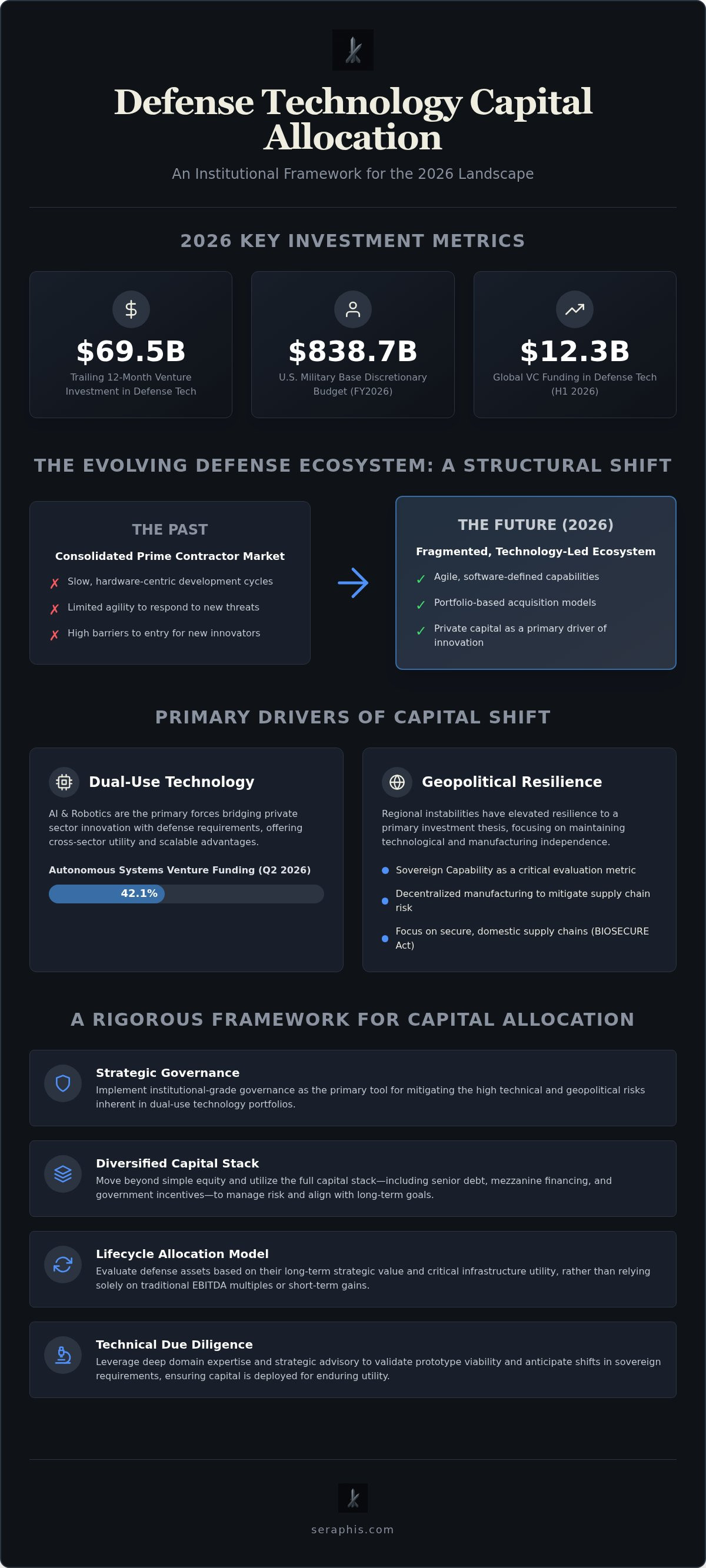
Defense innovation investment represents the deliberate deployment of capital into technological frameworks that redefine sovereign security and national resilience. The year 2026 marks a structural turning point where the historical dominance of consolidated "Prime" contractors is being challenged by a fragmented, technology-led ecosystem. This transition is supported by the U.S. Military Budget Overview, which highlights a base discretionary total of $838.7 billion for the 2026 fiscal year. Within this environment, defense technology capital allocation has shifted to prioritize software-defined capabilities and modular hardware. Global venture capital funding for this sector reached $12.3 billion in the first half of 2026 alone. Private capital now acts as the primary driver for accelerating the transition of laboratory prototypes into battlefield-ready systems, utilizing a new portfolio-based acquisition model implemented by the Department of Defense.
Dual-Use Technology: The Primary Driver of Capital Shift
Dual-use assets consist of technologies with significant applications in both the commercial and military sectors. In 2026, AI and robotics are the primary forces bridging the gap between private sector innovation and defense requirements. The autonomous systems segment alone captured 42.1% of quarterly defense tech venture funding in the second quarter of 2026. This concentration of capital suggests that global investment strategies are evolving to favor platforms that offer cross-sector utility. It's no longer enough for a technology to serve a single purpose. It must provide a scalable advantage that can be deployed across varied operational environments without the friction of traditional defense-only development cycles.
Geopolitical Resilience as an Investment Thesis
Recent regional instabilities have elevated geopolitical resilience from a secondary consideration to a primary investment thesis. Sovereign Capability has emerged as a critical metric for evaluating aerospace technology and infrastructure projects. This metric measures a nation's ability to maintain technological independence and manufacturing capacity during periods of supply chain disruption. Decentralized manufacturing models are becoming essential to mitigate the risks associated with concentrated production hubs. Legislative changes in 2026, characterized by the reauthorization of the Defense Production Act and the introduction of the BIOSECURE Act, mandate a focus on secure, domestic supply chains. Effective capital management in this sector requires a methodical evaluation of these geopolitical risks to ensure long-term stability for institutional portfolios.
Core Pillars of Defense Technology Capital Allocation
Effective defense technology capital allocation requires a transition from speculative venture models toward a system integration approach. This methodology necessitates balancing immediate liquidity needs with the protracted timelines characteristic of government procurement. Institutional investors should look beyond simple equity plays; instead, they must utilize the full capital stack, including senior debt, mezzanine financing, and government-backed incentives. The DoD's Strategic Capital Investment Strategy provides a foundational roadmap for how private capital can be aligned with national security priorities to ensure long-term technological superiority. By diversifying across these financial instruments, investors can better manage the idiosyncratic risks associated with aerospace and robotics development.
Technical due diligence serves as the primary mechanism for risk mitigation. In the defense sector, evaluating a prototype's viability requires deep domain expertise that standard financial analysis cannot provide. Strategic advisory becomes essential when navigating the transition from a laboratory environment to a validated military system. Institutional-grade insights allow investors to anticipate shifts in sovereign requirements, ensuring that capital is deployed into assets with enduring strategic utility. This methodical approach reduces the likelihood of capital being stranded in technologies that fail to meet rigorous military specifications.
The 'Valley of Death' and Capital Structuring
The gap between early-stage prototype funding and the award of a formal production contract remains the most significant barrier to successful defense innovation. In the context of 2026 defense procurement cycles, the 'Valley of Death' is defined as the precarious period where a technology has proven its technical merit but lacks the sustained capital runway to survive the multi-year testing and evaluation phases required for government adoption. Structuring capital to bridge this gap involves creating extended investment horizons that account for these bureaucratic delays. Investors must ensure that portfolio companies possess enough operational capital to withstand protracted evaluation windows without sacrificing technical development. This requires a patient, principled approach to capital management that prioritizes stability over rapid exits.
Regulatory Compliance and CFIUS Considerations
Allocating capital within the defense sector necessitates a sophisticated understanding of foreign investment oversight. The Committee on Foreign Investment in the United States (CFIUS) has expanded its reach, making strategic governance a requirement for any institutional portfolio. Compliance isn't merely a legal obligation; it's a strategic asset that preserves the integrity of sovereign technology and ensures future contract eligibility. Implementing strategic investment advisory: institutional frameworks for 2026 ensures that all capital movements remain transparent and aligned with national security mandates. For stakeholders seeking to optimize their position in this complex market, engaging with a private investment office provides the necessary oversight to manage these regulatory hurdles with precision and methodical care.
Overcoming Structural Barriers in Defense Market Entry
The prevailing perception of the defense sector as a closed environment for private capital is an outdated narrative that fails to account for recent acquisition reforms. In 2026, the Department of Defense's transition toward portfolio-based management has created accessible entry points for non-traditional contractors. This structural opening requires a disciplined approach to defense technology capital allocation, as successful market entry depends on more than just technical merit. Specialized investment offices provide the necessary strategic bridge between innovative startups and the established "Prime Contractor" ecosystem. These entities facilitate the high-level relationships and institutional trust required to navigate complex procurement cycles. Additionally, strategic banking investments play a vital role in providing the capital depth needed to scale manufacturing and infrastructure for emerging firms.
The Prime vs. Disruptor Dynamic
Large prime contractors are increasingly adopting an integration-focused model to maintain their technological edge in aerospace and robotics. This dynamic creates two distinct paths for private-capital-backed firms: standalone platform development or positioning for a strategic bolt-on acquisition. The pursuit of standalone growth necessitates substantial capital endurance, while the bolt-on path demands early alignment with a Prime's existing technical architecture. Private capital remains essential for maintaining a competitive edge in aerospace technology, as it allows smaller disruptors to iterate faster than the internal research and development departments of larger, more bureaucratic entities. Investors must decide whether to fund a standalone competitor or a specialized component that completes a Prime's existing capability gap.
Sovereign Data Sovereignty and AI
The deployment of artificial intelligence within defense portfolios necessitates a focus on sovereign data sovereignty. This involves the creation of secure, localized infrastructure that prevents external interference and ensures data integrity. This requirement creates unique capital demands that differ significantly from commercial, cloud-based AI models. While some institutional investors view AI in defense as high-risk, the 2026 landscape demonstrates that risk is effectively mitigated when capital is directed toward functional, battlefield-ready applications rather than speculative research. Strategic guidance for these assets focuses on moving beyond the hype of generative models to the practical implementation of autonomous logistics and predictive maintenance. This methodical approach ensures that AI investments contribute to tangible sovereign capabilities while maintaining the security protocols required by national defense agencies.
Strategic Frameworks for Long-Term Capital Deployment
The "Lifecycle Allocation" model serves as a comprehensive framework for managing the transition from early-stage innovation to mature, critical infrastructure. This approach requires investors to evaluate assets based on their strategic value to national security rather than relying solely on traditional EBITDA multiples. In many instances, a technology's importance to sovereign resilience provides a valuation floor that standard market metrics often overlook. Managing correlation across a diversified portfolio is equally critical, particularly when integrating defense and healthcare investments. These sectors frequently share underlying advancements in robotics and AI, yet they respond differently to market cycles, offering a degree of institutional stability during periods of global volatility. Private capital plays a vital role in maintaining this stability by providing the consistent funding required for long-term technical development.
R&D vs. Scaling: A Tiered Allocation Approach
Effective defense technology capital allocation distinguishes between the high-risk requirements of foundational research and the capital-intensive needs of mass production. High-risk R&D in quantum computing and autonomous systems requires patient equity that can withstand technical setbacks. Conversely, the industry is seeing a significant shift toward "scaling capital" for technologies that have achieved technical validation. The FY 2026 National Defense Authorization Act supports this transition by authorizing multi-year procurement for eight critical munitions, backed by an additional $1.9 billion to accelerate production capacity. This legislative support reduces the risk for private capital entering the mass production phase. For a deeper analysis of these pillars, refer to our guide on private capital for defense: strategic framework 2026.
Measuring Impact and Strategic Governance
In the defense sector, defining success necessitates a dual focus on financial performance and national security impact. Financial returns are a requirement for institutional sustainability, but the strategic utility of an asset often dictates its long-term viability across different political administrations. Strategic governance ensures that investments remain aligned with both ethical standards and sovereign mandates, preventing the reputational risks often associated with dual-use technologies. This structured oversight allows a portfolio to survive shifting political priorities by focusing on foundational capabilities that remain essential regardless of the current leadership. To implement these frameworks within your own portfolio, consider the advantages of a global investment strategy managed by specialized authorities.
The Role of Strategic Governance in Defense Portfolios
A private investment office serves as the optimal vehicle for defense technology capital allocation because it provides the institutional stability and long-term perspective that traditional venture platforms often lack. Managing assets in national security requires more than just capital deployment; it necessitates a structured approach to strategic governance that aligns with sovereign interests. Seraphis Group utilizes a methodology rooted in professionalism, institutional gravity, and methodical precision to ensure that every investment meets rigorous ethical and operational standards. By integrating global investment strategies with deep domain expertise, a specialized office can navigate regional defense requirements while maintaining a unified vision for the entire portfolio. This strategic advisory role is essential for optimizing outcomes in technically complex sectors like aerospace and robotics where the margin for error is minimal.
Institutional Gravity in Capital Management
Maintaining a composed, objective tone is critical when communicating with defense stakeholders and sovereign entities. The industry has moved past the "disruptor" trope, favoring the persona of a principled institutional leader who values stability and transparency. This shift in identity allows for more productive collaborations with government agencies and established prime contractors. Effective governance requires a formal structure that prioritizes methodical decision-making over rapid, speculative growth. For those seeking sector-specific guidance on these principles, our analysis of private capital for aerospace technology: a strategic investment framework provides a detailed roadmap for institutional participation. By adopting an authoritative and strategic stance, investors build the trust necessary to participate in sensitive, high-impact security projects.
Future-Proofing Portfolios for 2027 and Beyond
Anticipating the next wave of innovation is a requirement for maintaining a competitive advantage in the defense sector. As we look toward 2027, the focus of capital management is expanding to include bio-defense and space-based infrastructure. These emerging fields represent the next frontier of critical infrastructure, requiring specialized oversight to manage their unique technical and regulatory risks. Strategic governance remains the ultimate differentiator in defense innovation investment. It provides the framework necessary to survive shifting geopolitical climates and ensures that capital is always directed toward technologies with enduring strategic utility. Success in this landscape isn't defined by the speed of the entry, but by the resilience and precision of the long-term deployment strategy.
Advancing Sovereign Capability Through Strategic Deployment
The 2026 defense landscape requires a departure from speculative funding models in favor of a principled, Lifecycle Allocation approach. By prioritizing strategic value and sovereign resilience over short-term financial multiples, institutional investors can secure assets that remain essential across changing political cycles. Successful defense technology capital allocation now depends on the ability to bridge the gap between technical validation and mass production through methodical scaling capital.
Strategic governance acts as the definitive safeguard against the technical and regulatory complexities of dual-use innovation. Aligning private capital with national security mandates ensures that portfolios contribute to tangible sovereign independence while maintaining institutional stability. As global requirements for robotics, AI, and aerospace continue to evolve, the need for precise, expert-led oversight has never been more pronounced.
Explore Strategic Governance and Defense Investment Insights at Seraphis Group to leverage our specialized private investment office focus and global expertise in critical infrastructure. Our institutional-grade strategic advisory provides the clarity needed to navigate this high-impact sector with confidence. We look forward to supporting your long-term strategic objectives in this vital field.
Frequently Asked Questions
What is the 'Valley of Death' in defense innovation investment?
The 'Valley of Death' is the critical period between the development of a technological prototype and the award of a formal government contract for mass production. In the defense sector, this phase is often protracted due to rigorous testing and evaluation cycles. Investors must structure capital to provide an extended runway, ensuring that firms can maintain operational stability during these multi-year bureaucratic transitions without sacrificing technical momentum.
How does strategic capital allocation differ between defense and traditional tech?
Strategic defense technology capital allocation differs from traditional tech by accounting for a single, sovereign buyer and significantly longer procurement timelines. While traditional tech focuses on rapid user acquisition and quick exits, defense requires a Lifecycle Allocation model. This approach prioritizes national security impact and strategic utility. It often involves navigating complex regulatory hurdles that don't exist in purely commercial software or consumer hardware markets.
Is private capital for the defense sector subject to specific regulations?
Private capital is subject to stringent oversight, most notably through the Committee on Foreign Investment in the United States (CFIUS). Additionally, the FY 2026 National Defense Authorization Act includes specific provisions like the BIOSECURE Act, which restricts procurement from certain biotechnology companies. Investors must also adhere to the Defense Production Act, which provides the government with authorities to prioritize the defense industrial base during periods of strategic necessity.
What role does dual-use technology play in a 2026 investment strategy?
Dual-use technology serves as the primary driver for cross-sector investment strategies in 2026. These assets, which have both commercial and military applications, mitigate risk by offering alternative revenue streams outside of government contracting. Technologies like autonomous robotics and AI captured 42.1% of defense tech venture funding in the second quarter of 2026. This dual utility ensures that capital remains productive even during shifts in sovereign procurement priorities.
Can a private investment office manage the risks of government procurement?
A private investment office is uniquely positioned to manage procurement risks through specialized strategic governance and deep domain expertise. By providing institutional-grade insights, these offices help navigate the 'Prime Contractor' ecosystem and the complexities of sovereign security requirements. This methodical approach ensures that capital is deployed with the precision needed to survive long evaluation windows. It offers a structured alternative to the more speculative nature of standard venture capital platforms.
Why is strategic governance critical for AI and robotics in defense?
Strategic governance is essential for AI and robotics to ensure ethical alignment with national security mandates and to maintain data sovereignty. These technologies require secure, localized infrastructure that prevents external interference. Without rigorous oversight, portfolios may face significant reputational and regulatory risks. Governance frameworks provide the necessary transparency and methodical decision-making required to manage highly sensitive autonomous systems within a principled institutional framework that values long-term stability.
How do institutional grade investment insights improve defense portfolio returns?
Institutional-grade investment insights improve returns by enabling deeper technical due diligence and the ability to anticipate shifts in sovereign requirements. Investors can identify high-impact assets that offer long-term strategic value rather than chasing speculative trends. These insights allow for the identification of 'scaling capital' opportunities in technologies that have achieved technical validation. This methodical evaluation reduces the likelihood of capital being stranded in non-viable or non-compliant defense projects.
What are the primary exit strategies for defense technology investments in 2026?
Primary exit strategies in 2026 involve strategic acquisitions by large prime contractors or public listings for standalone platforms. As the Department of Defense shifts toward portfolio-based acquisition, primes are increasingly seeking 'bolt-on' technologies to fill specific capability gaps. Some firms may also pursue roles in providing critical infrastructure. These exits are typically driven by the strategic value of the technology to the defense industrial base rather than simple revenue multiples.


